About Sinopodophyllum hexandrum (Royle) T.S.Ying
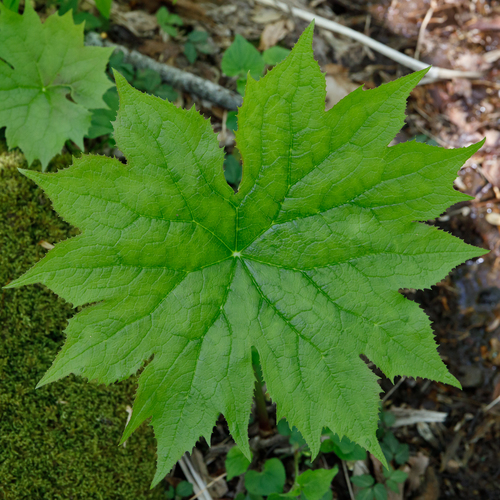
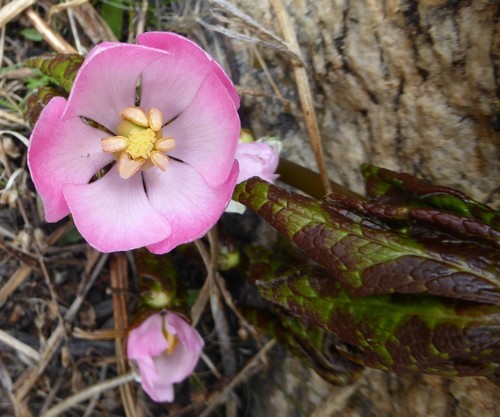
Sinopodophyllum hexandrum (Royle) T.S.Ying is a low-growing plant with glossy green, drooping, lobed leaves borne on a small number of stiff branches. It produces a pale pink flower and a bright red-orange bulbous fruit. Its attractive ornamental appearance makes it a popular choice for planting in woodland-style gardens. This species can be propagated either from seed, or through division of its rhizome. As a Himalayan native plant, it is highly tolerant of cold temperatures, but cannot tolerate dry growing conditions. In Hindi and Ayurveda, this species is known as bantrapushi or Giriparpat, and it is locally called 'ban kakdi' in Valley of Flowers National Park.
Sinopodophyllum hexandrum grows throughout the Himalayan region, ranging west to Afghanistan and northeast to Southwest China. It is reasonably abundant in Great Himalayan National Park located in Himachal Pradesh. A study conducted by C.P. Kala recorded that the plant has a density of roughly one individual per square meter on the fringes of Valley of Flowers National Park.
The root and rhizome of this plant are poisonous, though they are used as traditional medicine. These plant parts contain aryltetralin lignans that have anticancer, antifungal, and immunomodulatory properties. The rhizome also produces a resin that is commonly and commercially referred to as Indian Podophyllum Resin. This resin can be processed to extract podophyllin, also called podophyllotoxin, which is a neurotoxin. Rhizomes can contain up to 15% podophyllin. When administered in carefully controlled doses, the resin can be applied topically to treat genital warts.