About Simyra albovenosa (Goeze, 1781)
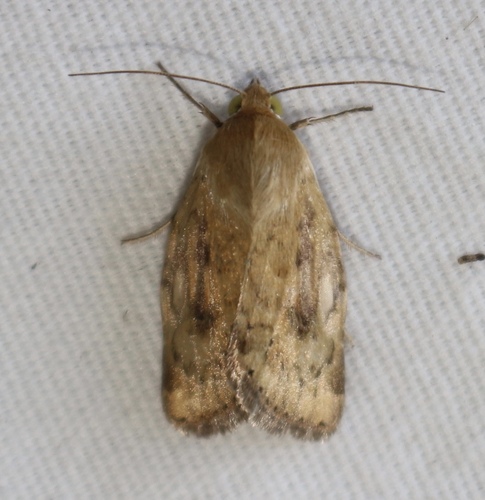
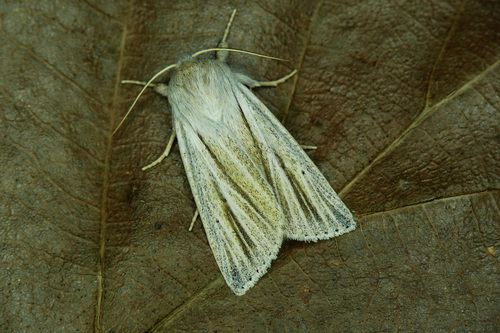
Simyra albovenosa, commonly called the reed dagger, is a species of moth belonging to the family Noctuidae. This species can be found across most of Europe, as well as in Turkey, Iran, Transcaucasus, and extends into the east Palearctic region including Central Asia and Siberia. The wingspan of adult moths measures 32–40 mm. The forewings are whitish-ochreous, and are sometimes dusted with dark fuscous; they have indistinct brownish streaks in the median, submedian, and dorsal areas, and occasionally have blackish terminal dots. The hindwings are white. The larvae are blackish or dark brown-grey with pale marbling; they have pale ochreous-yellowish subdorsal and subspiracular lines, which often bear reddish markings. The tubercles along these lines are yellow or orange, and the larvae bear fascicles of pale reddish-brown and black hairs. The larval head is black and marked with ochreous streaks. The larvae of Simyra albovenosa feed on a variety of plant species: Typha latifolia, multiple Juncus species including Juncus gerardii, Scirpus, Eleocharis palustris, Eriophorum, Elymus arenarius, Phalaris arundinacea, Phragmites communis, Festuca rubra, Festuca arundinacea, Salix, Rumex crispus, Filipendula ulmaria, Potentilla palustris, Angelica archangelica, Sonchus arvensis, and Aster tripolium. S. albovenosa lives in habitats of reed beds and fenland. Adults produce two generations per year, and are active on the wing from April through mid-September. Occasionally, a partial third generation will occur in the month of October.