About Simsia calva (A.Gray & Engelm.) A.Gray
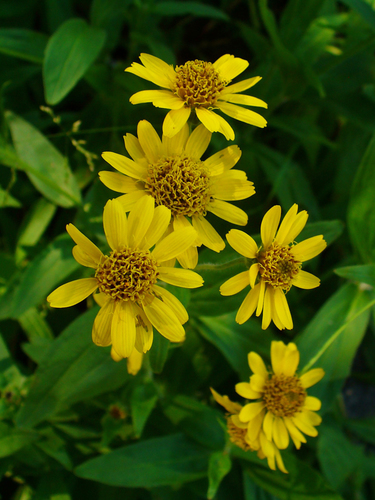
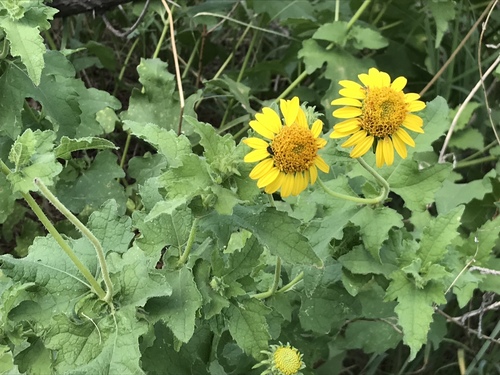
Simsia calva (A.Gray & Engelm.) A.Gray is a species in the genus Simsia, which includes annual plants, perennial plants, and subshrubs. Plants in the genus Simsia grow 20–400 centimeters (8–157 inches) tall, with stems that are either fully erect or ascending. S. calva has an average height of 30–150 cm (12–59 in). This species’ leaves are cauline in arrangement, and can be proximal or whorled. Its petioles are winged, and occasionally fuse at the base to form structures referred to as "discs". Leaf surfaces are hirsute to scabro-hispid, and most are gland-dotted. S. calva leaves are dilated at the base, forming fused discs, with ovate blades measuring 2–8 cm (0.8–3.1 in) by 1.5–6 cm (0.6–2.4 in); blades are sometimes 3-lobed. Like almost all plants in genus Simsia, S. calva has radiate flower heads. These heads grow either singly, or in groups of two or three arranged into a corymb. The peduncles of S. calva can match the length of the plant’s base, reaching a maximum length of around 30 cm (12 in) and a minimum length of 3 cm (1.2 in). A whorl of involucral bracts for the genus is campanulate, measuring 5–22 mm (0.20–0.87 in), and for S. calva measures 10 mm × 7 mm (0.39 in × 0.28 in) to 12 mm × 16 mm (0.47 in × 0.63 in). The phyllaries (bracts below the flower) for the genus number 11–66, and can be condensed or broad. For S. calva, phyllaries number 21–43, and are arranged subequally to equally. Simsia receptacles are generally low convex and paleate, meaning they have a scaly covering. Ray florets make up the showy, colorful outer portion of the flower head. For the genus, ray florets can be absent entirely or number up to 45, and can be any combination of orange-yellow, lemon-yellow, pink, purple, or white. S. calva has 8–21 ray florets that are orange-yellow, with brown or purple coloring that may appear as traces, lining, or cover the entire floret face. For the genus, disc florets number between 12 and 172; unlike ray florets, disc florets are fertile and bisexual. Their color varies by part: anthers are black or yellow, and corollas match the color of the species’ ray florets. S. calva has 90–154 disc florets, with anthers that are almost always yellow, and very rarely black. Cypselae are the dry fruits of Simsia plants, which develop from inferior ovaries. Fruits of the genus are flattened and occasionally hairy. S. calva cypselae measure around 4–6 mm. Pappi are structures that surround the fruits; pappi are generally absent in the genus Simsia, and in S. calva they are either absent, or very fine and reach up to 4 mm. S. calva flowers year-round, growing in a variety of soil types including sand and clay, as well as in rock crevices, on limestone, in prairies, in multiple types of pine forest, and along streams and roadsides. Within its ecosystem, it acts as a minor food source for large mammals, most commonly white-tailed deer. In the United States, S. calva is common across Texas, through the Trans-Pecos mountains, and extends into southeastern New Mexico.