About Simorcus asiaticus Ono & Song, 1989
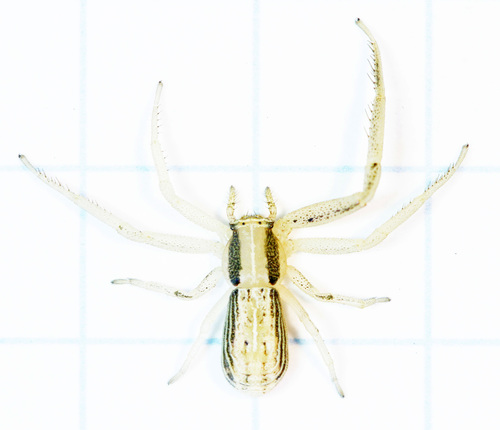
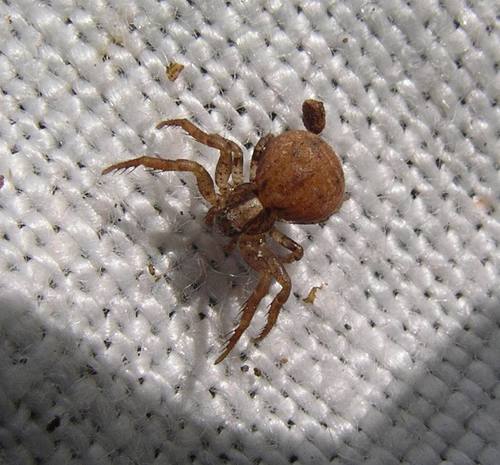
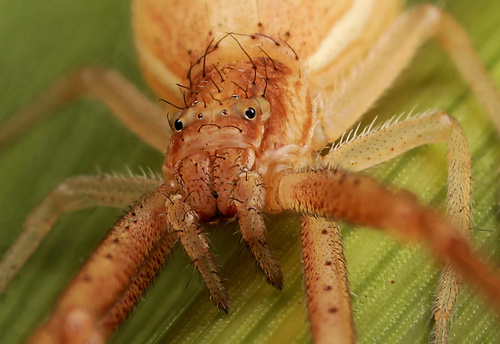
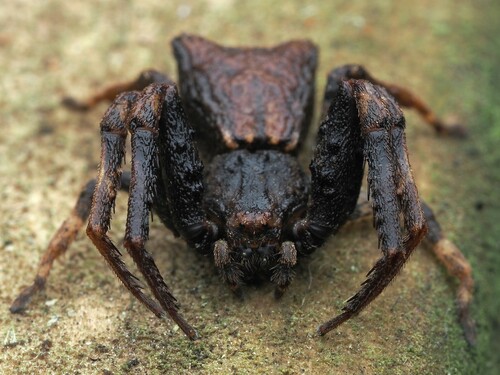
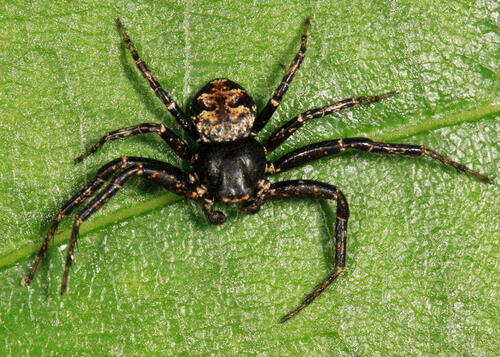
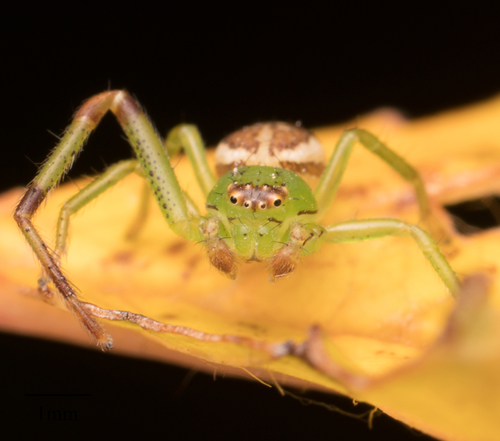
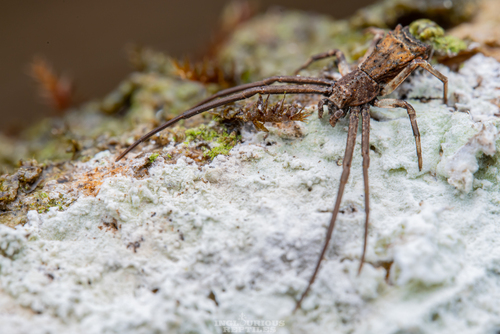
Simorcus asiaticus Ono & Song, 1989 is a species of crab spider that, like many other crab spiders, shows strong sexual dimorphism: females are notably larger than males. The average total body length of females is 7.78 mm, while males reach an average total body length of 5.28 mm. In both sexes, the cephalothorax is longer than it is wide, has well-developed tubercles, and is covered in short, blunt setae. The clypeus is unusually wide when compared to the eye region. The arrangement of its eyes follows the characteristic pattern of its family: posterior lateral eyes are the largest, followed by anterior lateral eyes, then posterior median eyes; anterior median eyes are the smallest. Its chelicerae have no teeth, and have strong setae growing on their dorsal surface. The maxillae are noticeably elongated and pointed, especially in females, and carry several blunt setae. The labium is also elongated. This species has long, slender legs that only bear strong hairs and have no spines. Claw tufts are completely absent, and the tarsal claws have between 3 and 5 teeth. Its legs follow the length formula I-II-IV-III, meaning the first pair of legs is the longest and the third pair is the shortest. The male pedipalp has a distinct structure: the tibia has both ventral and retrolateral apophyses. The ventral apophysis is long and shaped like a finger, while the retrolateral apophysis is well-developed and has a sclerotized distal tooth. The tarsus has five strong prolateral spines and includes a paracymbium. The palpal bulb has no apophyses; the embolic division wraps twice around the tegulum and ends in a long, spiniform embolus. The female epigyne is sclerotized and has long introductory openings. Its internal reproductive structure includes a soft, curved introductory canal and long, tubular spermathecae. Female specimens are beige with brown mottling across the cephalothorax; their chelicerae, maxillae, labium, and sternum are dark brown. The first two pairs of legs and the pedipalps are beige with darker ventral surfaces, while the third and fourth pairs of legs are yellowish-brown. The female opisthosoma is beige and has no distinct markings. Male specimens are considerably darker in overall coloration than females. This species has only been recorded from Sanmen County, Zhejiang, China, where the holotype and allotype specimens were originally collected.