About Simethis mattiazzii (Vand.) Sacc.
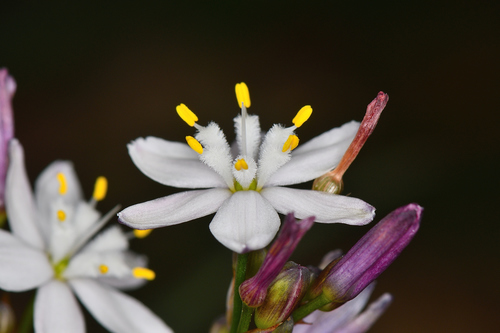
Simethis mattiazzii, commonly called the Kerry lily, is a perennial plant that grows to a maximum height of 25 cm (10 in). It has a vertical rhizome and fleshy roots. Its leaves grow from the base of the plant, reaching up to 30 cm (12 in) long; they are narrow, linear, grass-like, and sometimes curl. The inflorescence grows on a sparsely-branched, erect, wiry stem that bears a few small leaves and a loose spike of three to ten flowers that each have six tepals. Open flowers reach 2 cm (0.8 in) in diameter; they are purple-grey in bud and turn gleaming white when open. The six stamens have fuzzy white filaments tipped with yellow anthers. Its fruit is a three-lobed capsule. The Kerry lily flowers during May and June. This species has a scattered, mainly maritime distribution across Western Europe and North Africa. In the British Isles, the only confirmed location where it still grows is County Kerry in southwestern Ireland, where it is restricted to a 20 km2 (7.7 mi2) area around Derrynane. It was previously recorded in Dorset, southern England, but is now thought to be extinct there. It can also be found in western France, the Pyrenees, the Atlantic coastal strip of northern and western Spain and Portugal, the Mediterranean coastal strip of Morocco, Algeria and Tunisia, and at isolated sites in western Italy, Sicily, Corsica and Sardinia. A population on the Sicilian island of Marettimo was first discovered in 2012. Across its range, it inhabits grassland, heathland, maquis, shrubland, and cork-oak woodland. It is common in the Atlantic belt of Europe and the coastal strip of the Iberian Peninsula, and specifically more common in Brittany, the Loire Valley, and the northern flanks of the Pyrenees, but it is rare across many of its other scattered locations, and becomes much rarer further inland. The North African population is very fragmentary. This species has a relictual distribution, and southwestern Ireland marks its most northerly occurrence.