About Simarouba amara Aubl.
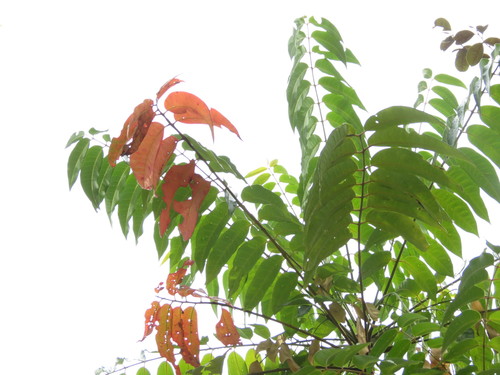
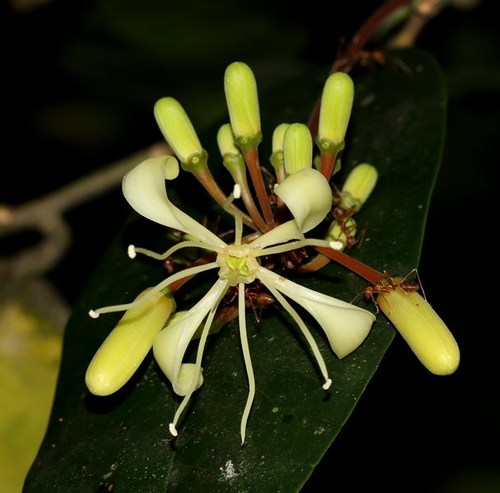
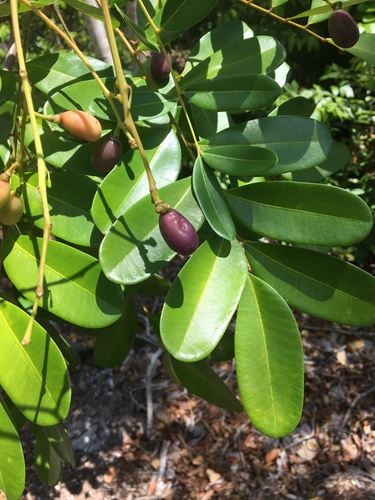
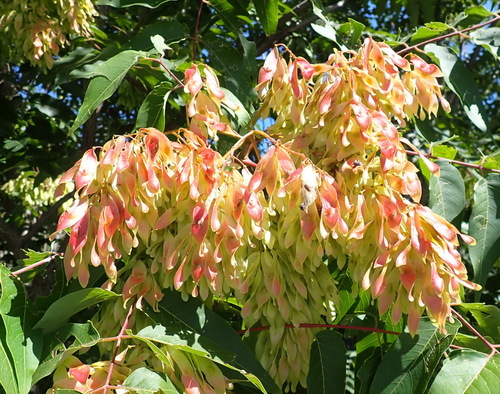
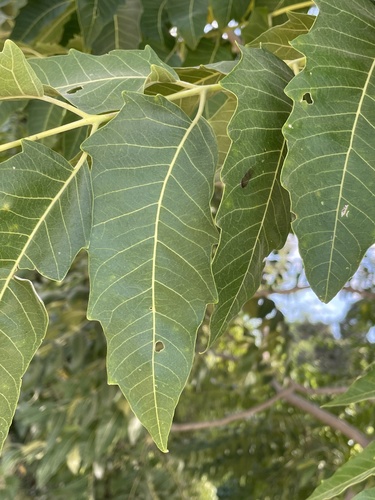
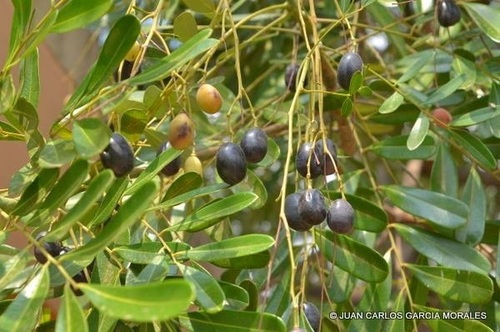
Simarouba amara Aubl. is a fast-growing, light-demanding, shade-intolerant evergreen tree species. It can reach a maximum height of 35 metres, a maximum trunk diameter of 125 cm, and a maximum estimated age of 121 years. It produces compound leaves that reach roughly 60 cm in total length, with 4–7 cm long petioles and 9–16 leaflets per leaf. Individual leaflets measure 2.5–11 cm long and 12–45 mm wide, with leaflets toward the end of the compound leaf typically being smaller. Flowers grow on a widely branched, densely flowered staminate panicle around 30 cm long. All flowers are unisexual, small (less than 1 cm long), and pale yellow; they are thought to be pollinated by insects such as small bees and moths. On Barro Colorado Island (BCI), Panama, this species typically flowers during the dry season from the end of January to the end of April, with flowering lasting 11 to 15 weeks each year. In Costa Rica, it flowers slightly later, between March and July, with a peak in April. Fruits develop between 1 and 3 months after pollination, and grow in groups of 3–5 drupes. Individual fruits are brightly coloured, ranging from green to purplish-black, measure approximately 17 mm long, and contain large seeds 10–14 mm long. Each seed weighs approximately 0.25 g, cannot remain dormant, and is dispersed by vertebrates. This species produces a new flush of leaves between January and April, during the dry season when rainforests receive the highest levels of light. This leaf phenology is thought to let S. amara photosynthesize most effectively, as new leaves are more efficient than the leaves they replace. It has visible but indistinct growth rings that average 7 mm wide. A study of S. amara individuals in Panama found they grow an average of 8.4 mm in trunk diameter per year; growth rates as fast as 18 mm per year have been recorded in Costa Rica. The tree stem grows continuously throughout the year. In mature trees, xylem vessels range from 20 to 90 μm in diameter, with roughly 50 vessels present per mm² of branch area. The wood of S. amara has a density of 0.37–0.44 g/cm³, which is lower than that of many other rainforest tree species. Young saplings of S. amara typically grow as a single straight pole, with several compound leaves and only one growing point. This structure lets saplings achieve maximum vertical growth with a minimum of biomass. Saplings begin branching once they reach 2–5 m in height. A study conducted in the forest dynamics plot on BCI found that around 65% of individuals died between 1982 and 2000, with the highest mortality occurring among small individuals with a trunk diameter at breast height (dbh) of less than 1 cm. Large trees over 20 cm dbh are relatively rare, averaging 2.4 trees per hectare, compared to 40 trees per hectare for individuals over 1 cm dbh. The natural range of S. amara covers the Neotropics, the ecoregion of Central and South America. Its range extends from Guatemala in the north to Bolivia in the south, and from Ecuador in the west to the east coast of Brazil. It has been introduced to the Caribbean islands of Dominica and Puerto Rico, and has become naturalized in Puerto Rico. On BCI, mature trees over 10 cm dbh occur at a frequency of 5 per hectare; the frequency is 0.7 per hectare in Ecuador and 0.4 per hectare in French Guiana. Genetic analysis of S. amara populations suggests the species has always been relatively common across its native range. It grows in both rainforests and savannahs. Due to its light-demanding growth habit, S. amara seedlings are rare in undisturbed primary forest. Individuals of S. amara do not typically reproduce until their trunk reaches 30 cm in diameter. Once mature, trees produce flowers every year, but not all female individuals produce fruit annually. While it has been reported that non-sphingid moths pollinate this species, other authors have questioned this claim, though its flower morphology matches that of species pollinated by generalist small insects such as bees and moths. In ecological studies on BCI, lianas are relatively rare on mature S. amara individuals over 20 cm dbh compared to other local tree species: only around 25% of mature S. amara host lianas. Researcher Putz has suggested this low liana occurrence may be due to the species' large leaves, but the mechanism that would reduce liana growth remains unknown. Smaller S. amara individuals also host fewer lianas and woody hemi-epiphytes than other tree species growing in the same forests. In Costa Rica, the ailanthus webworm (Atteva aurea) and other members of the genus Atteva have been recorded eating the new shoot tips of S. amara. Caterpillars of the butterfly species Bungalotis diophorus feed exclusively on S. amara saplings and treelets. In Panama, two termite species have been observed living on S. amara: Calcaritermes brevicollis lives in the tree's dead wood, while Microcerotermes arboreus nests in a gallery on one of the tree's branches. Bullet ants (Paraponera clavata) have been found nesting at the base of S. amara trees. The fulgorid hemipteran Enchophora sanguinea has been found to preferentially occur on the trunks of S. amara. Across areas where S. amara grows, local people use the tree's leaves and bark as an herbal medicine to treat dysentery, diarrhea, malaria, and other illnesses. In 1713, S. amara plant material was exported to France, where it was used to treat dysentery, and proved effective during dysentery epidemics between 1718 and 1725. A 1918 study confirmed the plant's treatment efficacy: soldiers in a military hospital were given a tea made from the bark to treat amoebic dysentery. In 1944, the Merck Institute found that S. amara treatment was 92% effective at treating human intestinal amoebiasis. During the 1990s, scientists demonstrated that extracts from S. amara can kill Entamoeba histolytica (the most common cause of dysentery), plus Salmonella and Shigella bacteria that cause diarrhea. However, more evidence is still required to fully confirm the medicinal efficacy of Simarouba. The main biologically active compounds found in S. amara are quassinoids, a group of triterpenes including ailanthinone, glaucarubinone, and holacanthone. These compounds have been reported to kill protozoa, amoebas, and Plasmodium, the parasite that causes malaria. Scientists first investigated the species' antimalarial properties in 1947; they found that in chickens, 1 mg of bark extract per 1 kg of body weight had strong antimalarial activity. In 1997, a patent was filed in the United States for the use of a S. amara extract in a skin care product. Simarouba amara is not the same species as Simarouba glauca, which is known as Lakshmi Taru in India.