About Silphium terebinthinaceum Jacq.
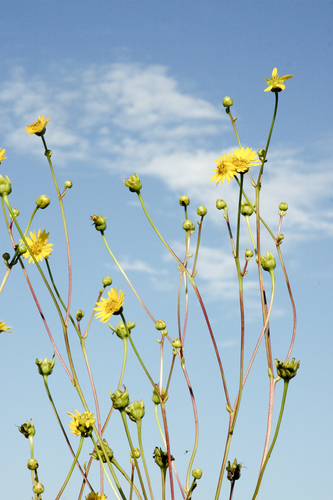
Silphium terebinthinaceum Jacq., commonly called prairie dock, is an herbaceous perennial dicot that grows 1 to 3 meters (3 to 10 feet) tall. It produces small yellow flowers 5 to 6 centimeters (2 to 2+1⁄2 inches) in diameter during the summer. Its leaves are rough-textured, spade-shaped, and oriented vertically in a north–south direction, a special adaptation for survival in prairie climates. One study found that most of prairie dock’s leaves are oriented within 15° of north, and 60° away from horizontal. This combination of north–south and vertical arrangement keeps leaf temperatures lower at midday, which helps the plant conserve water. Additionally, this unique trait gives the plant better access to sunlight for photosynthesis, creating a more efficient method of producing its carbon resources. Prairie dock also has a characteristically large taproot that can penetrate at least 4 meters (14 feet) deep to reach the water table. This species is native to the United States, ranging from Iowa, Missouri, and Arkansas in the west, south to Mississippi, Alabama, and Georgia, east to Virginia, and north to Wisconsin. In Canada, it is native to Ontario, where it is classified as critically imperiled. Habitats for Silphium terebinthinaceum include black soil prairies, gravel prairies, shrub prairies, and hill prairies. It also prefers growing along roads and railroads. Thanks to its ability to grow new above-ground shoots, prairie dock can survive destructive events like grazing and soil degradation. Its large taproot and uniquely oriented leaves also make it well-adapted to acquire and retain water. Native bees nest under or within these plants, or use parts of the plants for their nests, so prairie dock is thought to be an important species for attracting pollinating bees to the local area. It is one of the few species that successfully persists on land converted from prairie to railway. For cultivation, Silphium terebinthinaceum prefers full sun. It is a drought-resistant plant that thrives in environments from slightly dry to moist. While it favors deep loamy soils, it tolerates gravelly and rocky soils. This plant develops slowly, but mature individuals are strong and difficult to kill. Even though it is a robust plant, harsh conditions can still affect it: brown patches can develop on leaves after drought, windstorms, or direct leaf damage. It recovers quickly after wildfires, due to its very deep taproot. Like Silphium perfoliatum (cup plant), prairie dock was used medicinally by Native Americans. A tea made from the plant was used to relieve lung bleeding, reduce menstrual bleeding, and act as an emetic. Root tea was also used to treat liver problems, fever, and enlarged spleen. Smoke from the plant was used to treat nerve pain, relieve congestion, and treat rheumatism. This plant is considered potentially toxic.