About Silphium perfoliatum L.
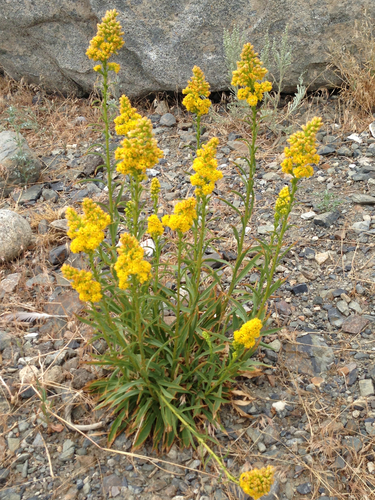
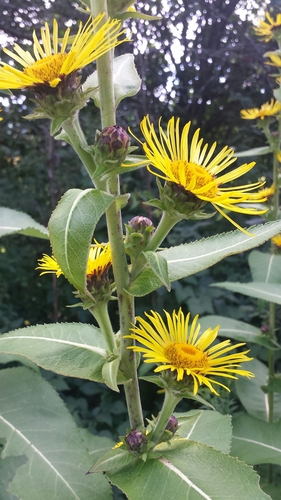
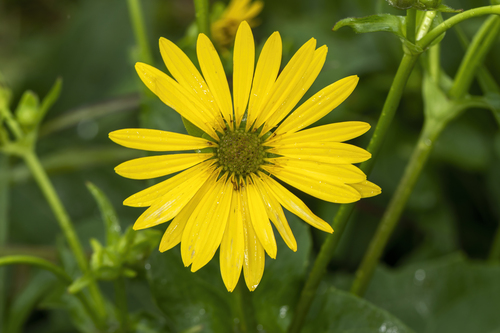
Silphium perfoliatum L., commonly called cup plant, typically grows 1–2.5 m (3–8 ft) tall. Its stem is stout, smooth, slightly hairy (glabrous), and strongly four-angled like mint stems. Leaves are opposite, toothed, and ovate; their widely winged petioles fuse around the stem to form a cup shape. The first flower forms at the tip of the main stem, with additional flowers growing on side branches later. Flowers bloom from midsummer to autumn. They resemble small sunflowers, reaching approximately 2.5 cm in diameter with golden yellow ray florets. The center of each flower holds small, sterile tubular disk florets. These disk florets are structurally bisexual, but only their stamens are fertile, so they do not produce seeds. Their corollas are tubular, 5-toothed, and have an undivided style. Ray florets are female, and develop into thin brown achenes with a marginal wing for wind dispersal. Each flower head produces 20 to 30 seeds; individual seeds are 9 to 15 mm long, 6–9 mm wide, flattened, and 1 mm thick. Insect pollinators including bees, butterflies, and skippers enable cross-fertilization to produce seeds. Vegetative reproduction allows this species to form large colonies via its central taproot and shallow rhizomes. A multi-rhizome clone grown from a single seed has been recorded at 15 years old, and roots from specimens grown in botanical gardens are estimated to be over 50 years old. This plant has an extensive root system and does not transplant well unless it is very young. It uses the C3 carbon fixation metabolic pathway, and is well-adapted to withstand extreme weather and harsh growing conditions. Its roots stay dormant over winter and can survive temperatures as low as −30 °C (−22 °F), with an optimal growing temperature of 20 °C (68 °F). Silphium perfoliatum naturally grows in sandy moist bottom lands, floodplains, near stream beds, and in or adjacent to open woodland. Currently it is found across multiple US states (Alabama, Arkansas, Connecticut, Georgia, Iowa, Illinois, Indiana, Kansas, Kentucky, Louisiana, Massachusetts, Maryland, Maine, Michigan, Minnesota, Missouri, Mississippi, North Carolina, North Dakota, Nebraska, New Jersey, New York, Ohio, Oklahoma, Pennsylvania, South Dakota, Tennessee, Virginia, Vermont, Wisconsin, West Virginia) and two Canadian provinces (Ontario, Quebec). It is listed as a threatened species in Michigan, and classified as a prohibited highly invasive species in New York State. Silphium perfoliatum is considered a promising potential energy crop, as it has low requirements for climate, soil conditions, and previous crop rotation, while producing high volumes of biomass. Research from the Thuringian State Institute of Agriculture suggests it can be used as an alternative crop for biogas production. Reported annual biomass yields vary in existing literature: in the second year of cultivation, it produces 13 to 20 tons of biomass per hectare, and one experiment in Thüringen, Germany recorded 18 to 28 tons of dry biomass per hectare. Arable cultivation of this species for biogas production is growing increasingly common in Germany. Its invasive potential in Central European countries is considered low, but spread via wind, birds, and harvesting machinery is possible. Extra care is recommended when growing it near moving water to prevent it from spreading and establishing on sensitive riverbank ecosystems, similar to the spread of Buddleja davidii. While its primary use is as an energy crop, it can also serve as a fodder plant for farm animals. It contains amino acids, carbohydrates including inulin in its rhizomes, L-ascorbic acid, terpenes with essential oils, triterpene saponins, carotenoids, phenolic acid, tannins, and flavonoids. It has high feed value for meat and milk-producing livestock, thanks to its long lifespan and high protein content, and can be stored as silage. Harvesting twice a year is recommended, as the stem becomes too tough with high fiber content if left to grow longer. The high water content of the first June cutting is not a problem if the plant is allowed to wilt briefly. Its blooming period lasts eight or more weeks. The long bloom time and abundant flowers make it a good resource for honey production from bees, yielding an average of 150 kg of honey per hectare per year. The resulting honey is high in fructose and crystallizes slowly. For medical use, this species produces resin with an odor similar to turpentine, and it contains both gum and resin; its root has been used for medicinal purposes. Historically, the resin was made into chewing gum to stop nausea and vomiting, and to freshen breath. Native Americans collected the resinous sap by cutting the top off the plant stalk. The Winnebago Tribe believed a potion made from the rhizome granted supernatural powers, which tribal members drank before hunting. The Chippewa tribe used root extract to treat back and chest pain, reduce excessive menstruation, and treat lung hemorrhage. In spring, tender young leaves were harvested and eaten cooked or in raw salads. Powdered Silphium perfoliatum has diaphoretic and tonic properties, and can ease symptoms of fevers, dry cough, asthma, spleen illness, heart disease, and liver disease. Leaf extract has been shown to lower cholesterol and triglyceride levels in blood. Studies indicate phenolic acids in the species are responsible for its antiseptic activity, and that it stimulates production of the IgG and IgM antibodies, and stimulates bile production in the gall bladder. It is also grown as a pollinator-friendly and bird-friendly ornamental garden plant. Its flowers attract many pollinators, while its seeds and the cup-shaped stem structures that hold water provide food and water for birds. It was introduced to the United Kingdom and the Soviet Union in the 1750s, and has been valued as an ornamental plant since that time. Carl Linnaeus formally named the species in 1759. In the United Kingdom, it has been awarded the Royal Horticultural Society's Award of Garden Merit. It is sold by many native plant nurseries and some specialty nurseries in the US and Canada, and is rarely available from conventional nurseries. It is commonly used in prairie and native meadow restoration projects, and in native naturalistic landscapes and gardens. It is only infrequently used in conventional landscapes and gardens, mostly by landscape designers and architects who recognize it as a unique perennial. A large patch of Silphium perfoliatum was planted at Millennium Park in Chicago, Illinois, near the Lurie Garden, in 2010. For gardening and landscaping use, it grows best when planted in groups rather than as individual specimens; its tall growth habit makes single flower stalks more prone to falling over.