About Silphium laciniatum L.
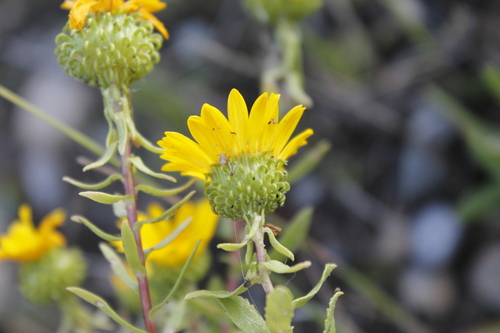
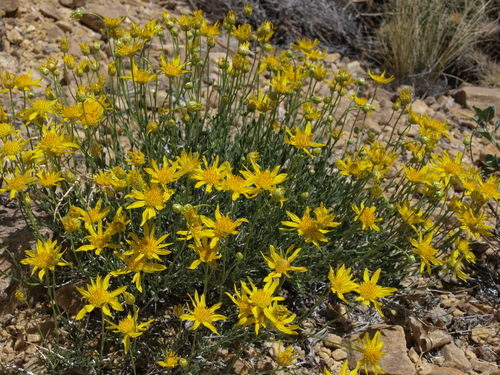
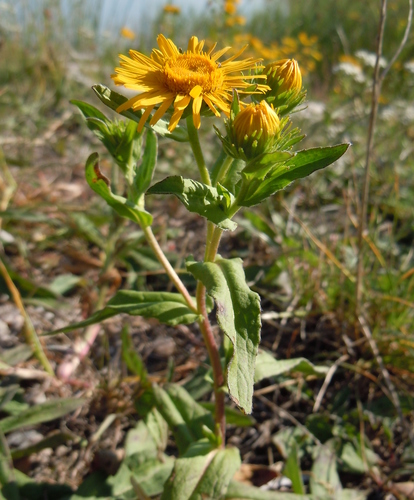
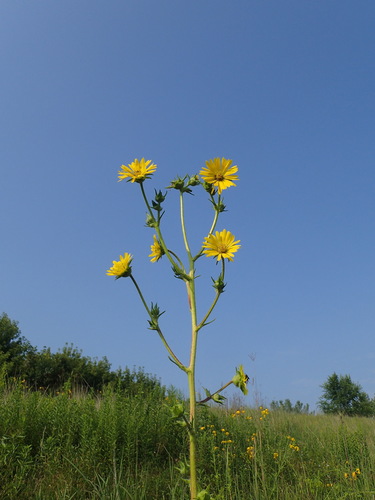
Silphium laciniatum L. is a taprooted perennial herb that grows rough-haired stems usually reaching 1 to 3 meters in height. Its leaves vary in shape and size, measuring 4 to 60 cm long and 1 to 30 cm wide. The leaves are hairy, with either smooth or toothed edges, and may be borne on petioles or lack petioles entirely. The back of the plant's flower head bears layers of rough, glandular phyllaries. Each flower head holds 27 to 38 yellow ray florets, alongside many yellow disc florets. The fruit is a cypsela that can reach almost 2 cm in length, tipped with a pappus made of two short awns.
Ecological surveys of the insect fauna of this plant, commonly called compass plant, have recorded many different insect taxa, often occurring in large numbers. A single plant can grow up to 12 stems. Surveys counted an average of nearly 80 individual insects on each stem or within the stem tissues. The vast majority of insects found on the stems are gall wasps Antistrophus rufus and A. minor, along with many types of parasitoids that attack these gall wasps. The gall wasps, especially A. rufus, inject eggs into the plant's stem, which triggers the formation of a gall in the plant tissue. The wasp larva lives and feeds inside the gall, overwinters within the gall, and emerges as an adult the following spring. A single stem can hold more than 600 galls; for this plant species, the galls form internally and are generally not visible from the outside. Adult female A. rufus find suitable oviposition sites by detecting plant volatiles (a mix of monoterpenes) emitted by the fresh growing stem of their host. Male A. rufus also use these plant volatiles to search for mates. Females mate immediately after emerging from their galls, and males use volatiles to locate galls containing females, a behavior confirmed by the movement of the males' antennae across the plant's surface. Males will then wait at the gall for the female to emerge.
Other insects associated with the plant include several species of parasitoid wasps that attack A. rufus larvae inside the galls; the two most common are Eurytoma luta and Ormyrus labotus. Additional parasitoid species include Eupelmus vesicularis and species from the genera Brasema and Homoporus. The beetle Mordellistena aethiops lives on this plant, with its larvae boring into the stems. This beetle is in turn attacked by parasitoid wasps from the genera Schizopyramnus, Heterospilus, and Tetrastichus. Many species of birds and mammals feed on the fruits of Silphium laciniatum. The eastern kingbird perches on the tall plant to watch for insect prey. Livestock find the plant palatable.
Native American groups used this plant for a variety of purposes. Its bitter, resinous sap could be processed into chewing gum. The Pawnee people prepared a tisane (herbal tea) from the plant. Many groups burned the dried root as a charm during lightning storms. Silphium laciniatum is also cultivated in gardens.