About Silphium integrifolium Michx.
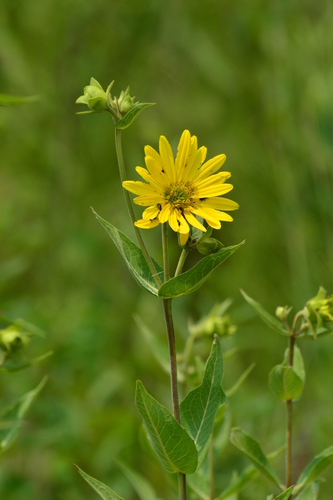
Silphium integrifolium Michx. is a perennial herb that grows from a fibrous root system, producing stems up to 2 meters (6 ft 7 in) tall. It can form a large clump containing up to 100 stems. Stems range from hairless to slightly rough-haired, and sometimes have a waxy texture. Its leaves are stemless and oppositely arranged along the stems, and basal leaves are lost by the time the plant reaches maturity. Leaf blades are lance-shaped to ovate, with smooth or toothed edges, and range from hairless to rough-haired, growing up to about 23 cm (9 in) long. The inflorescence holds between one and 15 flower heads. Each flower head is lined with 2 or 3 rows of phyllaries, which are hairless or rough, sometimes glandular, and have rounded bases with pointed tips. The head holds up to 36 yellow ray florets and many yellow disc florets. Its fruit has a short pappus. There are two recognized varieties of this species. Silphium integrifolium var. integrifolium grows between 40 and 200 cm (1 ft 4 in to 6 ft 7 in) in height. Silphium integrifolium var. laeve is generally 100 to 150 cm (3 ft 3 in to 4 ft 11 in) tall, produces more florets, and has hairless leaves. In terms of ecology, the plant's foliage is eaten by herbivores including white-tailed deer and the blister beetle Epicauta fabricius. Plants have been recorded losing approximately 17% of their fruits to lepidopteran larvae. The most common herbivorous insect found on this species is the gall wasp Antistrophus silphii. The wasp injects its eggs into the plant's apical meristem; as the larvae develop, a spherical gall up to 4 cm (1+1⁄2 in) wide forms in the meristem, which stops the shoot from growing. Up to 30 larvae overwinter inside each gall, pupate, and emerge as adult wasps the following growing season. This species is reported to be a host and nectar plant for many species of bees, butterflies, and moths. Historically, the plant had uses among Native American peoples: the Meskwaki, for example, used the roots to treat pain from injuries. Today, this species is cultivated for garden use. Compared to other Silphium species, it is shorter, less likely to topple over, and reaches flowering from seed more quickly. While it looks similar to sunflowers (Helianthus), it is more manageable than most perennial sunflowers because it spreads more slowly, and it is not known to be allelopathic. Researchers at the Land Institute, working with a number of collaborating institutions, have started a project to domesticate this species for use as an oilseed crop. It is also under consideration as a good companion plant among solar panels.