About Silene virginica L.
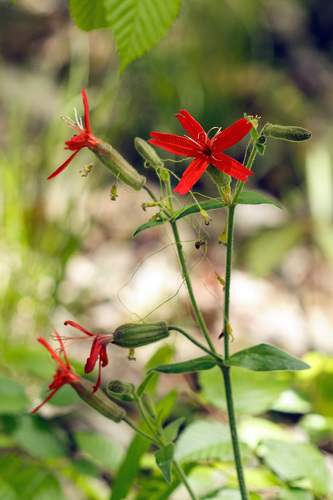
Silene virginica L., commonly called fire pink, is a short-lived small perennial herb that grows 20–80 cm (8–31 in) tall, with lance-shaped leaves. Flowering stems grow from the center of basal leaf rosettes starting in late winter to early spring. They first grow outward, then arch upward as they mature. Stems are reddish on the sun-exposed side, and greener on the shadier side. Stems, like the bases of the flowers, are covered in short sticky hairs called trichomes. A cyme of three to ten flowers forms at the end of each stem. Fire pink blooms in early summer, usually from late May to early July. Each flower is approximately 3–5 cm (1–1.5 in) across, with five notched, brilliant red petals that extend into a long corolla tube. Each flower has ten pale-red stamens with yellow anthers that form a ring around three pale-red styles that grow from the flower's center. Fruiting happens in mid to late summer, when flowers are replaced by tan capsules that hold seeds. The seeds are gray, kidney-shaped, and 1.5 mm long. The best time to identify fire pink is from May to July, when its distinctive red flowers are present. Fire pink has sequential development of its sexual parts: five stamens emerge first. After pollen is removed, anthers fall off and the stamens wilt. Once this is done, the next five stamens emerge. Last to emerge in the sequence are the three styles, which develop after anthers are lost and the remaining stamens have wilted. These styles push the second set of stamens away from the flower's center, and the stigmas become receptive to pollen. This dichogamous separation of reproductive development timing makes fire pink a highly outcrossing species, and reduces the chance of self-pollination. Fire pink grows in central and eastern North America, ranging as far west as Texas, as far south as Florida, and as far north as southern Ontario. It is fairly common across the core of its range, but considered rare in the outlying parts of its range. It is protected as a state endangered species in Wisconsin, Florida, and Michigan, and is imperiled in Louisiana. Its native habitats are open woodlands, rocky slopes, cliffs, and road banks. Fire pink prefers partial sun and well-drained soils. It can tolerate full sun but grows best in a mix of sun and shade. It is tolerant of drought and high temperatures, and typically grows in acidic, lower-quality soils. Flowering plants have evolved various attractive features including bright colors, fragrance, and large floral displays to attract pollinators. Vibrant red flowers often provide nectar rewards, and are especially attractive to hummingbirds that feed on this resource. Fire pink's main pollinator is the ruby-throated hummingbird (Archilochus colubris). Fire pink has floral traits that fit the hummingbird pollination syndrome: it is brightly colored, produces no detectable scent, has no landing pads, and holds nectar deep inside its corolla tube. This flower structure, specifically the long corolla tube and lack of features that attract or accommodate other pollinators, means fire pink's nectar reward is only accessible to hummingbirds, or less commonly, long-tongued invertebrate pollinators. As a result, fire pink has a very specialized relationship with the ruby-throated hummingbird, and relies on this hummingbird species to transfer pollen between individual flowers as the bird searches for nectar. In addition to its relationship with hummingbird pollinators, fire pink forms a symbiotic relationship with other birds that help disperse its seeds. Its seeds attract small birds including sparrows, juncos, and pine siskins. A notable ecological trait of fire pink is its sticky glandular hairs. These hairs, which cover the upper stem and flower calyx, trap insects to stop them from feeding on nectar and robbing the flower without providing pollination services. This is not a form of carnivory, as the hairs do not produce any digestive enzymes. Instead, it is a passive defense that protects the flower's developing structures and prevents nectar from being taken by organisms that do not aid pollination. Traditionally, fire pink was used for medicine by Native Americans and European settlers. The Cherokee people used fire pink's root as a primary treatment for snakebite. Its roots were also decocted to treat intestinal worms. Iroquois tribes used fire pink as an antibacterial medicine. Other tribes report that fire pink is poisonous. In modern times, fire pink may be used decoratively in rock gardens or along border fronts in landscaping.