About Silene uniflora Roth
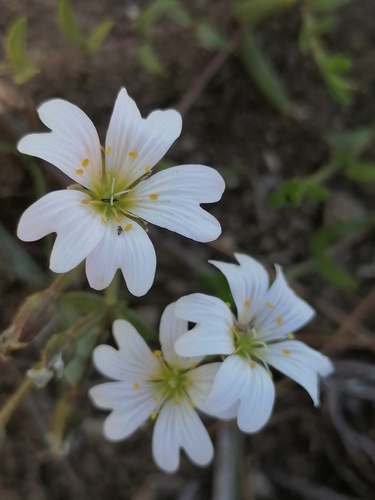
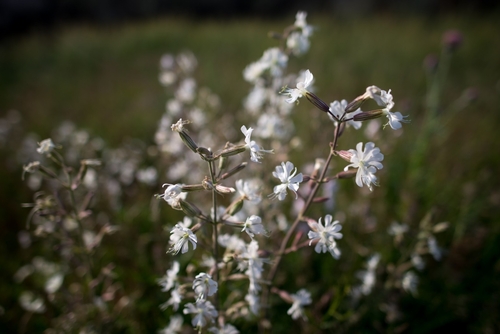
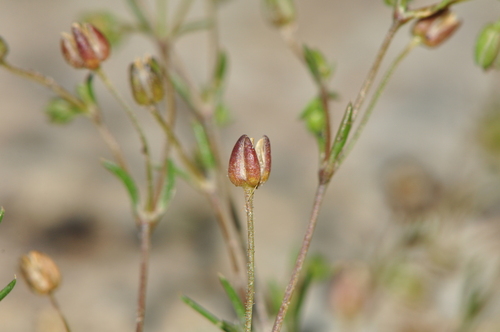
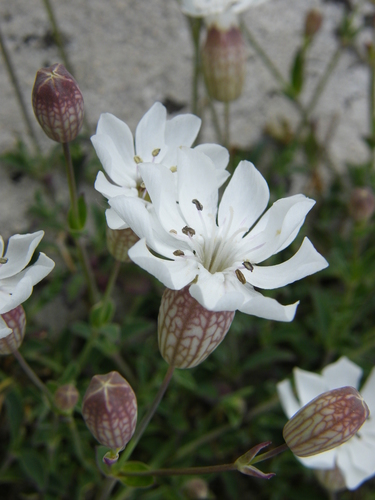
Silene uniflora Roth is a perennial mat-forming plant, with outward-growing stems that reach 10 to 40 cm in length. It produces a large thick main storage root, similar in form to the roots of carrot or turnip. Stems may grow along the ground, turning upward toward their tips. Its leaves are hairless, glaucous grey-green from a covering of natural waxes, with a fleshy texture. Leaves occur in a range of shapes: lanceolate, oblanceolate, elliptic, or spatulate. Flowers are white, with five deeply notched petals; the five sepals are fused and inflated to form a bladder-like structure. Each flower has three pistils and three stamens, which are almost entirely enclosed by the flower. It resembles bladder campion (Silene vulgaris) but typically bears solitary flowers. Silene uniflora is a maritime species that occurs across many European countries, growing almost entirely along coasts bordering the Atlantic Ocean and Baltic Sea. In northern Europe, it is native to the coasts of Scandinavia, including Finland, Denmark, Sweden, Norway, and Russia east to the Kola Peninsula. According to POWO, it is also native to Poland. It is not native to, and does not occur in, the Baltic States or the Russian coast of the Baltic Sea. In western Europe, it is native to the west coast of France, the northern coast of Spain, and a restricted area in northern Portugal. It grows along all the shorelines of Ireland and the United Kingdom, and also occurs rarely in some mountainous areas near fresh water. Further into the Atlantic Ocean, it is native to the Azores, Canary Islands, Madeira, and Iceland. It has been introduced to Germany, Argentina, and New Zealand. It is a long-lived perennial that colonizes coastal shingle that has been stable for 5 to 20 years, and also grows in dunes and at beach strandlines.