About Silene sedoides Poir.
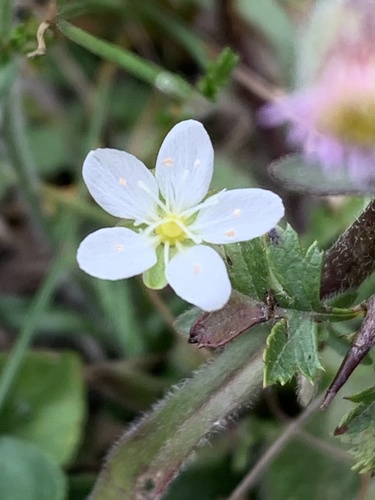
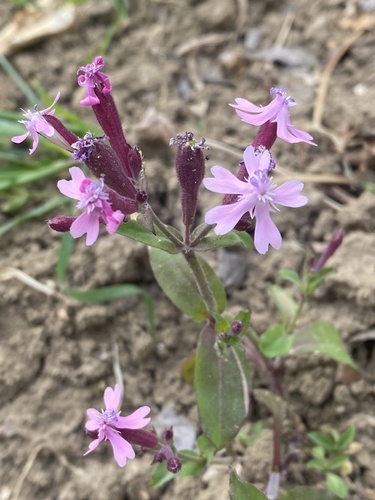
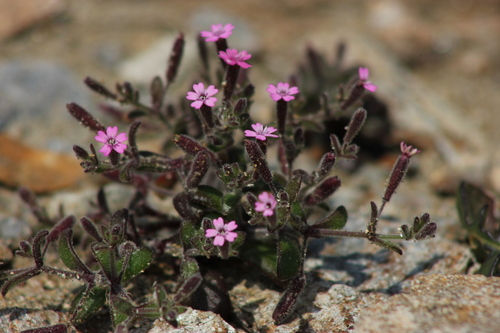
Silene sedoides Poir. is an annual herb with ascending stems. Its basal leaves are usually 0.5 to 4 cm long and are somewhat glabrous, meaning almost hairless. Stem leaves range from spoon-shaped (spatulate) to narrowly obovate, which is egg-shaped and wider near the tip. Its flowers grow in branched clusters called cymes; these clusters branch equally when young, but later often shift to one-sided branching called monochasia. The calyx, the outer floral envelope, is cylindrical during flowering, then becomes slightly club-shaped (clavate) as the fruit develops, and measures 5–8 mm in length. The petals are typically white to pink, often have a small notch at the tip (emarginate), and have a distinctive dark spot at the base. The capsule is narrowly ovate, membranous, and at least twice as long as its supporting stalk, the gonophore, which usually swells when it reaches maturity. The seeds are small, 0.5–0.6 mm wide, rounded, and have smooth or slightly bumpy (mamillate) surfaces. This species grows mainly in rocky, sandy, or gravelly habitats in the maritime supralittoral zone, the area just above the high-tide line. It occasionally appears a small distance inland as a plant of disturbed sites, called a ruderal. Its distribution covers a broad area around the Mediterranean: it extends from Spain and France eastward through Italy, Greece, Turkey, Cyprus, and the Middle East, and reaches as far west as North Africa. Within Greece, it is common and grows in coastal environments. In other locations, its occurrences are more sporadic and less frequent.