About Silene latifolia Poir.
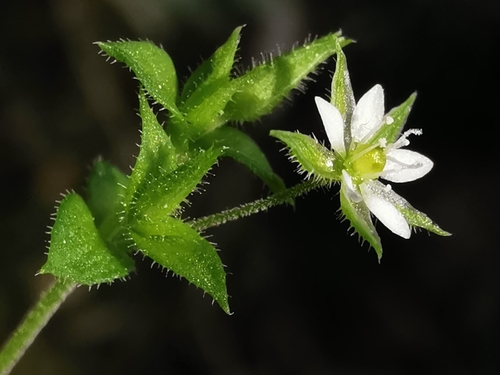
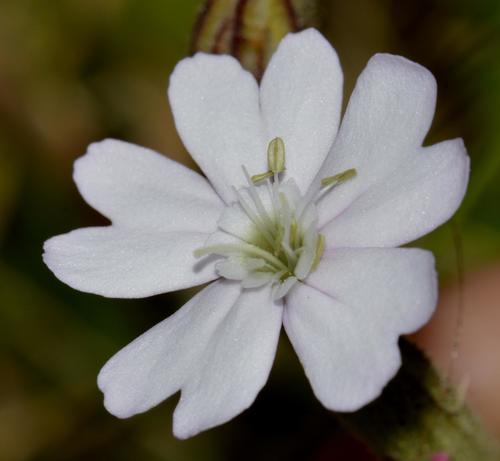
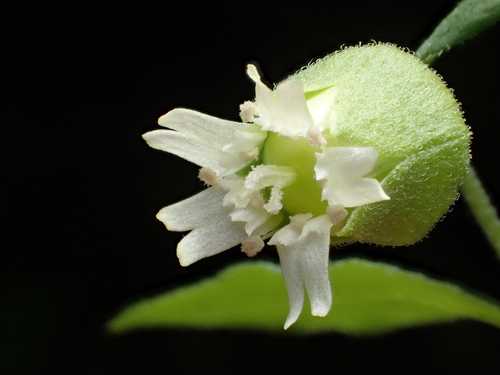
Silene latifolia Poir., commonly called white campion, is a dioecious flowering plant in the Caryophyllaceae family, native to most of Europe, Western Asia, and northern Africa. It is a herbaceous annual plant, occasionally biennial or short-lived perennial, reaching 40 to 80 centimeters in height. In the United States, it is sometimes referred to as bladder campion, though this name more commonly refers to the separate species Silene vulgaris. The plant's appearance changes with age: young plants form a basal rosette of oval to lanceolate leaves that are 4 to 10 centimeters long, while older plants produce forked stems that bear leaves in opposite pairs. Flowers grow in clusters at stem tops, and measure 2.5 to 3 centimeters in diameter. They have a characteristic inflated calyx and five deeply notched white petals, with flowering occurring from late spring to early autumn. The entire plant is covered in dense hairs. Occasional plants with pink flowers are usually hybrids between this species and red campion (Silene dioica). White campion grows in most open habitats, especially wastelands and fields, and is most common on neutral to alkaline soils. While it can thrive in a wide range of conditions, it prefers sunny locations with rich, well-drained soil. One ecoregion where it occurs is the Sarmatic mixed forests. In parts of England, it is called the Grave Flower or Flower of the Dead because it often grows on gravesites and around tombstones. It has become naturalized in North America, where it is found across most of the United States, with the highest concentrations in the north-central and northeastern regions of the country. It is believed to have been introduced to North America as a component of ship ballast. The Ojibwe people use an infusion of the alba subspecies of this plant as medicine.