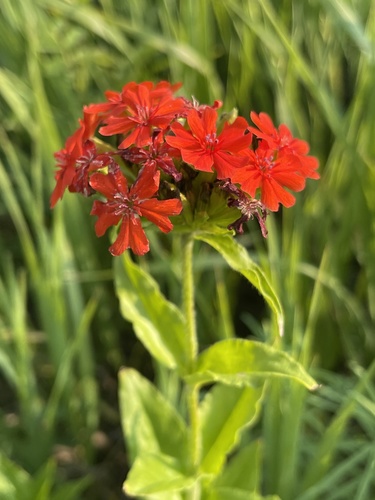
About Silene chalcedonica (L.) E.H.L.Krause
Silene chalcedonica (L.) E.H.L.Krause is a perennial herbaceous plant that grows 35–100 centimetres (14–39 inches) tall, with unbranched stems. Its simple, broadly lanceolate leaves grow in opposite pairs; each leaf measures 2–12 cm (1–5 in) long and 1–5 cm (1⁄2–2 in) across. Bright red flowers grow in clusters holding 10 to 50 flowers. Each flower is 1–3 cm (1⁄2–1+1⁄4 in) in diameter, with a deeply five-lobed corolla; each of the five main lobes is further split into two smaller lobes. This creates an overall shape similar to the Maltese cross, which is the origin of one of its common names. The plant produces a dry capsule fruit that holds numerous seeds. This species is native to central and eastern Russia, Kazakhstan, Mongolia, and northwestern China, and has become naturalised in some parts of North America. In the northern United States and Canada, it can be found along roadsides, other disturbed areas, and open woodlands. It is a popular ornamental garden plant, and has earned the Royal Horticultural Society's Award of Garden Merit. Numerous cultivars have been selected, with flower colours ranging from bright red to orange-red, pink, or white. It grows best in partial to full sun, in any good well-drained soil with a constant supply of moisture. Removing faded flowers will extend its flowering period. It is short-lived when grown in poorly drained soil. Double-flowered cultivars are propagated by division.