About Silene acaulis (L.) Jacq.
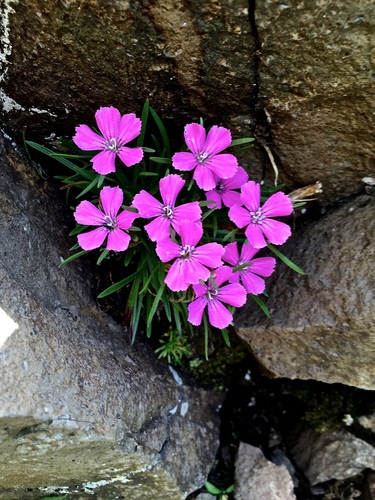
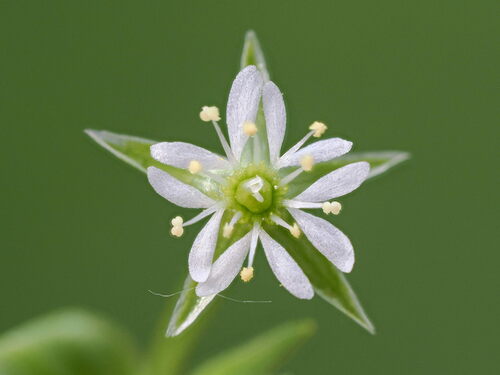
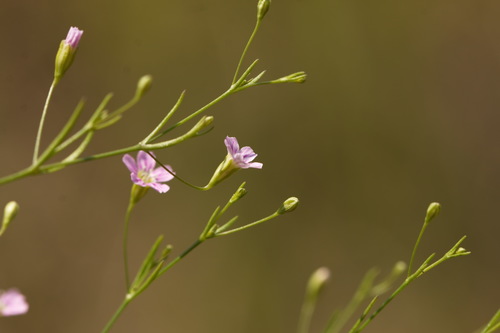
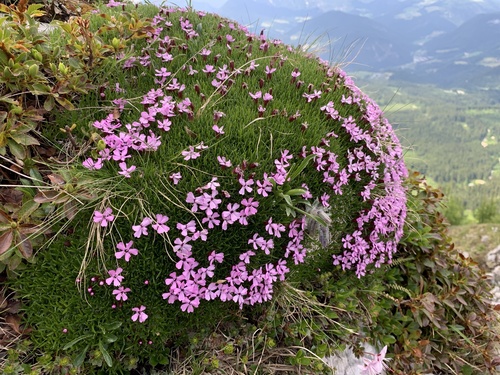
Silene acaulis, commonly called moss campion, is a low, ground-hugging plant that often forms dense, moss-like mats. Its dense cushions can reach one foot or more in diameter; the oldest recorded moss campion is 350 years old and two feet in diameter. Bright green narrow leaves grow from the plant's base, and dead leaves from previous seasons persist for years. In Colorado, moss campion plants are estimated to live 75 to 100 years, while Alaskan plants may reach 300 years of age. Pink flowers are borne singly on short stalks up to 2.5 centimeters (1 inch) long, though they are usually much shorter. Flowers are most often pink, very rarely white. They are solitary, star-shaped, and can be female, male, or hermaphrodite. Flowers measure 6–12 millimeters (1⁄4–1⁄2 in) wide, with hermaphrodite flowers larger than female flowers. Female flowers produce higher quality seeds than hermaphrodites, and male flowers produce higher quality pollen than hermaphrodites. A cushion of moss campion can change the gender of its flowers between years. Gender frequencies shift with altitude: the frequency of female flowers increases at higher elevation. Flowers appear from June through August. The flower is held by a firm, thick calyx; sepals are joined into a tube that conceals the bases of the entire petals. Ten stamens and three styles extend well beyond the throat of the flower. Stems and leaves are very sticky and viscid, which may deter ants and beetles from climbing the plant. Two varieties are recognized: variety exscapa has shorter flowering stems, while variety subacaulescens, native to Wyoming and Colorado, produces pale pink flowers throughout the summer. Moss campion is common across the high arctic and the higher mountains of Eurasia and North America, ranging south to the Alps, Carpathians, southern Siberia, Pyrenees, British Isles, Iceland, Faroe Islands, and Rocky Mountains. In the United States, it grows in Alaska, Colorado, the Bighorn Mountains of Wyoming, the Wallowa Mountains of Oregon, the Olympics, the northern Cascades of Washington, and is also found in Arizona, Idaho, Maine, Montana, New Hampshire, New Mexico, Nevada, Utah. In Canada it occurs in Alberta, British Columbia, Labrador, Newfoundland, Nova Scotia, Northwest Territories, Nunavut, Ontario, Quebec, Saskatchewan, Yukon. It is also found in Greenland, and Saint Pierre and Miquelon. It inhabits alpine fellfield, windswept rocky ridges and summits above the treeline. It grows mainly in dry, gravelly locations, but can also grow in damper spots. When sunlight hits the plant's cushion, it creates a warmer microclimate inside the cushion with higher temperatures than the surrounding environment. In Maine, moss campion is possibly extirpated, and in New Hampshire, Silene acaulis var. exscapa is listed as threatened. Experimental warming causes moss campion cushions to start flowering substantially earlier than control cushions grown at ambient temperature. Both male and female phases develop faster in open-top chambers, capsules (fruits) mature earlier, and cushions produce more mature seeds with a higher seed-to-ovule ratio, leading to an overall positive reproductive response in the short term. However, a study of four populations across a North American latitudinal gradient found that southern moss campion populations have lower survival and recruitment rates, but higher individual growth rates, than more northern populations. Vital rates including growth, survival, and fruits per unit area increase in moderately warmer years, but decline in the very warmest years. This suggests that a shift to a warmer climate, or more frequent unusually warm summers, may eventually lead to negative impacts for the species. Another study found that while short-term responses to warming are positive, they become negative over the medium term, indicating moss campion may be at risk from future global warming. Projections under different climate scenarios suggest S. acaulis will likely experience rapid climate-driven decline in suitable habitat across the British Isles and North America, and upward and northward shifts to new climatically suitable areas are unlikely in the future. There is no formal listing classifying moss campion as toxic, but it contains saponins. While saponins are toxic, they are hard for the human body to absorb, and can be broken down by thorough cooking. It is advised not to consume large amounts of this plant. For cultivation, seeds should be sown early in spring. After germination, seedlings should be potted individually, and it is recommended that they overwinter in a greenhouse for their first winter. To clean seeds, rub the capsules through a screen. Division takes place in spring, and it is advised to plant out new divisions in late spring or early summer. Moss campion should be grown in well-drained soil in full sun, and can tolerate cool climates. Historically, the plant was used to treat colic in children. Raw root skin of the plant was eaten as a vegetable in Iceland and Arctic regions.