About Sigesbeckia orientalis L.
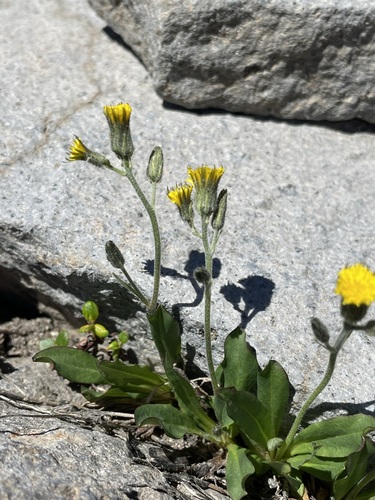
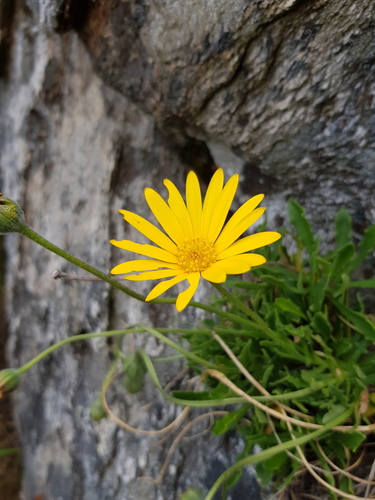
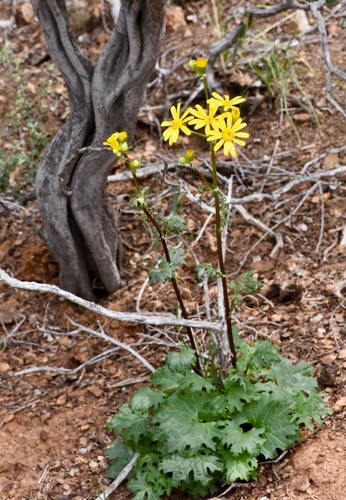
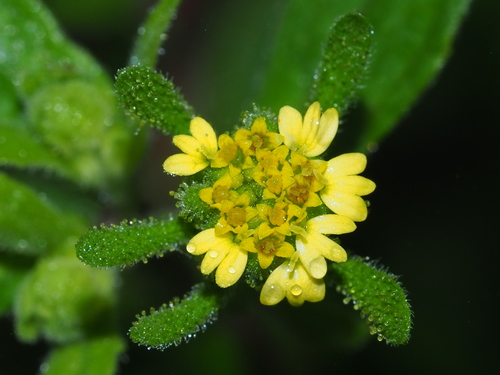
Sigesbeckia orientalis L. is an annual, upright herb or subshrub that grows 0.4 to 1.5 meters (1 foot 4 inches to 4 feet 11 inches) tall. It is usually multi-branched, with hollow, reddish stems. Its leaves range in shape from triangular, lance-shaped to broadly lance-shaped, and grow up to 2 to 17 centimeters (0.79 to 6.69 inches) long and 1 to 7 centimeters (0.39 to 2.76 inches) wide. Leaf petioles reach up to 2 centimeters (0.79 inches) long, and the underside of the leaf bears small yellow glands. Both upper and lower surfaces of the leaf blade are sparsely hairy and rough-textured. Leaf margins have pointed to rounded teeth, with larger teeth located closer to the leaf base; leaves gradually narrow toward the tip, and have a wedge-shaped base. The species produces yellow or orange flowers, arranged in heads that hold approximately 15 sessile flowers per head. Each flower head is around 10 millimeters (0.39 inches) in diameter, and typically contains both female and hermaphrodite flowers. There are roughly 8 ray florets, each with a 1 to 2 millimeter (0.039 to 0.079 inch) long ligule, and 10 to 15 disc florets. Its fruit is a dark brown to black cypsela, 2 to 3 millimeters (0.079 to 0.118 inches) long, which is curved and ridged. Sigesbeckia orientalis flowers and fruits in all months of the year. The species has a broad native distribution across Africa and Asia, but has become widely naturalized outside of this native range. There is ongoing scientific debate about whether it is native to Australia; the National Herbarium of New South Wales classifies the species as native to Australia. It is a widespread species in Australia where it grows on river banks and in shallow, stony sites.