About Sidalcea hendersonii S.Watson
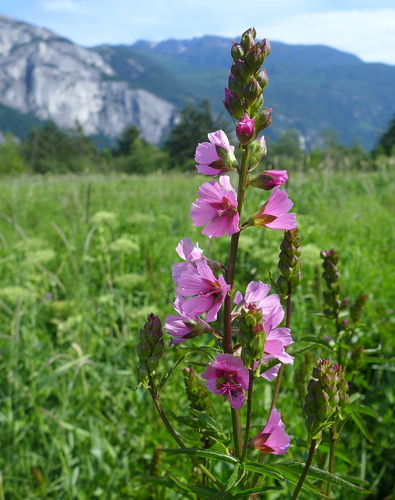
Sidalcea hendersonii is a perennial herb with a taproot, growing from thick, stubby rhizomes. It produces a basal rosette of toothed basal leaves. Its stems are erect, hollow, and usually tinged purple. This species produces numerous five-petaled flowers, typically fifty or more per individual, arranged in branched racemes at the top of stems. After flowering, it develops capsular seed fruits that have 5 to 10 chambers, each holding one seed. This species occurs in coastal areas stretching from southern Oregon to Vancouver Island and mainland British Columbia, with its range following the coastline; it grows in tidal marshes and meadows. It is extremely rare in Oregon, uncommon in Washington, and rare in British Columbia. Because Sidalcea hendersonii requires wet soil, its range is restricted to low-elevation tidal marshes and flats that experience inundation. Its occurrences are scattered, spanning from southern British Columbia to the mouth of the Umpqua River. NatureServe lists this species as at risk, noting that it is restricted to coastal tidelands and marshes of the Pacific Northwest, ranging south to Douglas County, Oregon and north to Vancouver Island, British Columbia, Canada. A recent collection in Alaska indicates a possible range extension. Outlying populations are located in Oregon and British Columbia, while the majority of the global population occurs in Washington state. There are an estimated 21 to 100 total occurrences, with an estimated total plant count of over 3,000 individuals, and a more likely estimate of over 10,000 individuals. There do not appear to be any imminent threats to this species.