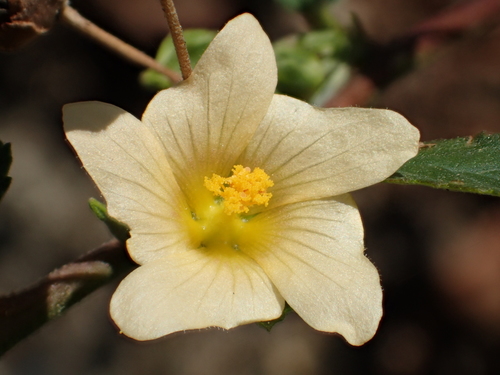
About Sida rhombifolia L.
Scientific Name and Stem Characteristics
This species, scientifically named Sida rhombifolia L., has branched stems that grow between erect and sprawling habits, reaching 50 to 120 centimeters in height, with woody lower stem sections.
Leaf Shape and Arrangement
Its dark green, diamond-shaped leaves are arranged alternately along the stem, measuring 4 to 8 centimeters long.
Leaf Petiole Traits
Leaf petioles are less than one-third the length of the leaf blade.
Lower Leaf Surface Features
The lower leaf surface is paler and covered in short, grayish hairs.
Leaf Margin Characteristics
The apical half of each leaf has toothed or serrated margins, while the basal half has smooth margins.
Stipule Features
Small spiny stipules grow at the base of each petiole.
Native Distribution
Sida rhombifolia is native to tropical and subtropical regions ranging from Africa through India and Southeast Asia to Japan, as well as Indonesia and the Philippines.
Introduced Distribution
It has been introduced to tropical and subtropical areas of North America, South America, Australia, Pacific islands, and parts of Europe.
Disturbed Habitat Preferences
This species most often grows on disturbed waste ground including roadsides, rocky areas, stock camps, and rabbit warrens.
Pasture Weed Status
It can become a competitive weed in pastures, since it is unpalatable to livestock.
Additional Habitat and Elevation Range
It also grows in savannahs, thick scrub, hillsides, and swampy woodlands, and as a tropical species it occurs only at elevations below 2,000 meters above sea level.
Stem Craft Uses
The stems of arrowleaf sida (Sida rhombifolia) are used to make rough cordage, sacking, and brooms.
Stem Fiber Trade History
Stems produce high-quality fiber, and was historically exported from India and other regions as “hemp”.
Leaf Nutrient Content
Chemical analysis has found that the leaves contain notable nutrient levels: 74,000 to 347,000 ppm protein, 94,000 to 475,000 ppm carbohydrates, 33,000 to 167,000 ppm fiber, 14,000 to 71,000 ppm fat, and 16,000 to 81,000 ppm ash.
Root Alkaloid Content (First Study)
One study recorded 450 ppm total alkaloids in the roots, along with ephedrine and saponin.
Root Alkaloid Content (Second Source)
Another source reports the root contains 0.1 percent total alkaloids, including choline, pseudoephedrine, beta-phenethylamine, vascin, hipaphorine, and related indole alkaloids.
Unpalatability Cause
The presence of these compounds is thought to contribute to the species’ unpalatability to cattle.
Medicinal Cultivation Status
Arrowleaf sida has well-documented medicinal uses, and it is cultivated for medicinal purposes across India.
Traditional Medicinal Applications
Pounded leaves are used to reduce swelling, fruits are used to ease headaches, mucilage from the plant is used as an emollient, and roots are used to treat rheumatism.
Recreational and Beverage Uses
In Mexico, the leaves are smoked, and in India a stimulating tea is prepared from the leaves.