About Sida corrugata Lindl.
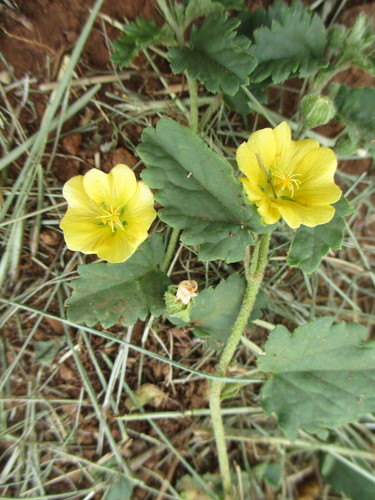
Sida corrugata Lindl. is a decumbent or prostrate perennial plant that spreads to 30 cm (12 inches) in diameter. Its stems are either smooth or covered in a dense layer of matted hairs. Leaves are arranged alternately along the stems; they are hairy, narrowly ovate or linear in shape, measuring 5–50 mm (0.20–1.97 in) long and 2–10 mm (0.079–0.394 in) wide. Leaf bases are either rounded or nearly heart-shaped. The upper leaf surface is grayish green to dark green, while the lower surface is paler; leaf margins are finely toothed, and leaves attach to stems via a 1.3–2.3 mm (0.051–0.091 in) long petiole. Flowers have five yellow petals that are 5–6 mm (0.20–0.24 in) long. Calyx lobes are 1.5–2.5 mm (0.059–0.098 in) long, triangular, and taper to a pointed apex. Flowering can occur at any time of year. The fruit is a deeply corrugated, globe-shaped mericarp, 5 mm (0.20 in) in diameter, densely covered in short, soft hairs. This species, commonly called corrugate sida, grows in a range of habitats across New South Wales, Queensland, Victoria, South Australia, and the Northern Territory. It occurs in grasslands and woodlands, growing in clay, fertile loam, and sandy soils.