About Sicyos angulatus L.
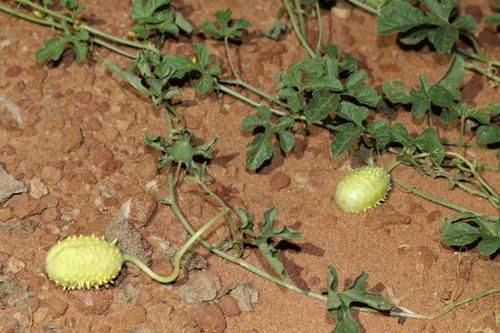
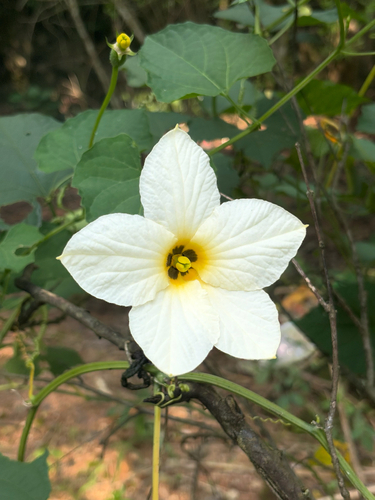
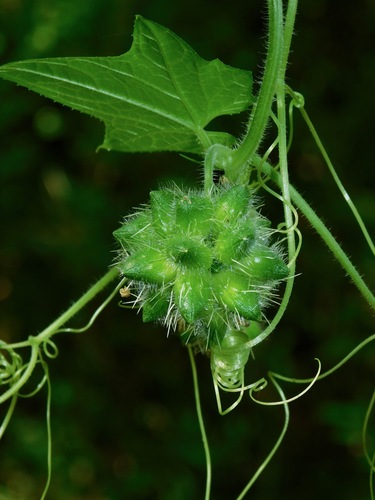
This annual vine, Sicyos angulatus L., produces long, branching stems that climb over shrubs and fences, or trail across the ground. Stems are hairy, pale green, and furrowed. Its alternate leaves have three to five palmate lobes and can reach 8 inches (20 cm) across. Leaf margins are slightly toothed; the upper leaf surface is usually hairless, while the underside has fine hairs, particularly along the veins. The thick, hairy petiole is around 5 inches (13 cm) long, and the leaf has a deep indentation at the point where it attaches to the petiole. Branched tendrils grow opposite some leaf-stem junctions, while flower stalks grow opposite other junctions. This species is monoecious, bearing separate male and female flowers on the same plant. Male flowers grow in long-stemmed racemes; each individual male flower is approximately 0.3 inches (0.8 cm) wide, with a calyx of five pointed teeth, a whitish five-lobed corolla with green veins, and a central cluster of stamens. Small female flowers grow clustered together on a short stalk; each flower has an ovary enclosed in a spiny, hairy fruit, and produces one seed. Fruits grow in small clusters, and are around 0.5 inches (1.3 cm) long. They start green and turn brown as they mature, and are dispersed by animals that brush against their bristly surface. Sicyos angulatus L. is native to Ontario and Quebec in Canada, and to the eastern and southern United States, ranging as far west as North Dakota and Texas. It grows in fertile, moist habitats including floodplains, damp grassland, thickets, bushy areas, river banks, ditches, and field verges, and prefers disturbed ground. Nectar from the plant's flowers attracts bumblebees, honey bees, various flies, and both sphecid and vespid wasps. Some bees also collect pollen from the plant's male flowers. A number of insect species feed on Sicyos angulatus L., including Anasa armigera (the horned squash bug), Anasa repetita, the spotted cucumber beetle, the striped cucumber beetle, and the leaf beetle Acalymma gouldi. Herbivorous mammals generally avoid eating this plant. The cooked foliage of Sicyos angulatus L. can be eaten as a green vegetable. A decoction made from this plant is recorded as being used in traditional Native American medicine to treat venereal disease.