About Sicalis luteola (Sparrman, 1789)
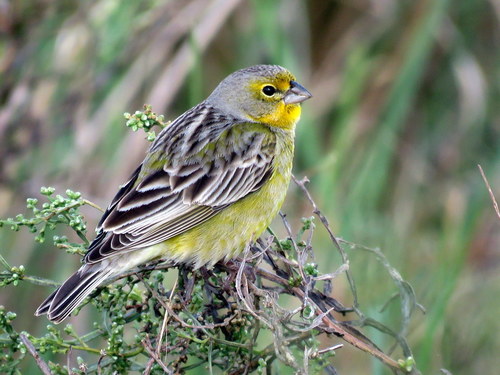
The grassland yellow finch, scientifically named Sicalis luteola, is a small passerine bird. Despite its common name, it is not a true finch, but rather a type of seedeater. This group was formerly classified alongside buntings and American sparrows in the Emberizidae family, but modern classification places it within the tanager family. It is a non-migratory resident across tropical South America, ranging from Colombia south and east to the Guianas, central Ecuador, Peru, and Brazil. Populations that breed further south in Argentina and Uruguay migrate to Bolivia and southern Brazil, including the cerrado region, during the austral winter. Isolated populations also exist in Central America and Mexico. The species was first documented on Trinidad in 2004, and is thought to have colonized the island from nearby Venezuela. It has also been recorded on Barbados, and has been present there since at least 1960. As its name suggests, the grassland yellow finch inhabits fields and other open grassland habitats. The female builds a grassy cup nest in tall grass, and lays 3 pale blue-green eggs marked with brown speckles. Multiple pairs may nest close to one another in areas with suitable habitat. This species reaches approximately 12 cm in length and weighs around 13 g. Males have bright yellow underparts and rump, with olive-yellow upperparts. Their crown and nape feature dark streaking, and there is yellow plumage surrounding the eye. Females have dark-streaked pale brown upperparts and dull yellow underparts. Its call is a sharp te-tsip. The male’s song, produced from a perch or during a display flight, is a sequence of chips, buzzes, and trills. Grassland yellow finches feed on seeds and insects, and they are typically observed in pairs or small groups.