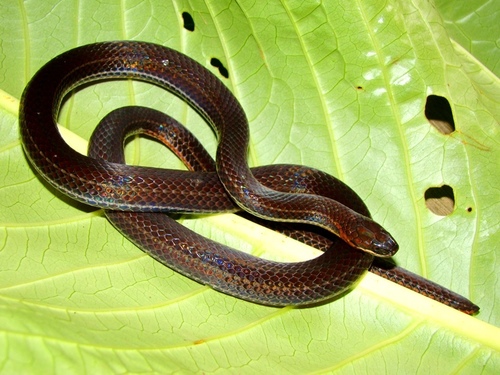
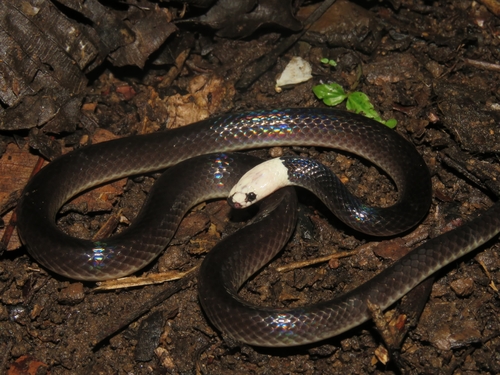
About Sibynophis subpunctatus (Duméril, Bibron & Duméril, 1854)
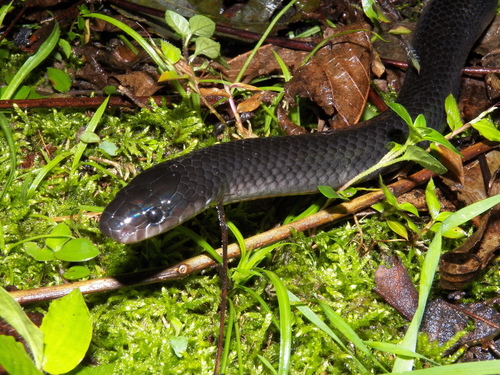
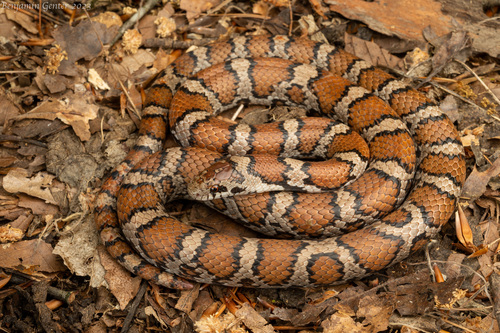
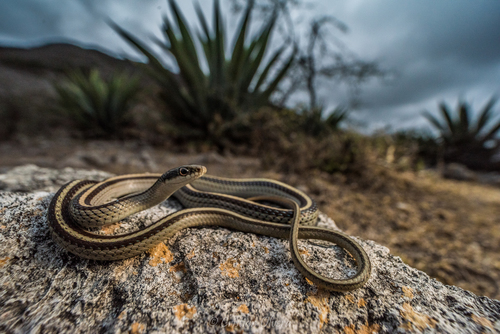
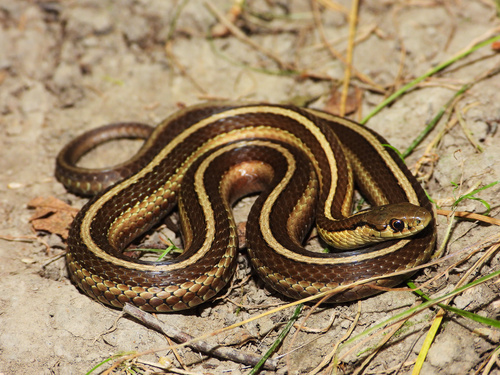
The maximum length recorded for Sibynophis subpunctatus is 18 inches, or 46 centimeters. This species has a rostral scale that is nearly twice as broad as it is deep. The suture between the internasals is slightly shorter than the suture between the prefrontals. The frontal scale is longer than the distance from its edge to the tip of the snout, and is the same length as the parietal scales or slightly shorter. The loreal scale is longer than it is deep. There is one preocular scale and two postocular scales, and both postoculars make contact with the parietal. Temporal scale arrangement is 1 (or 2) + 2. There are 9 or 10 upper labial scales; the fifth and sixth, or fourth, fifth, and sixth upper labials enter the orbit. The eighth upper labial is usually excluded from the labial margin, resembling a lower anterior temporal. Four lower labial scales contact the anterior chin shields; the first lower labial is usually separated from the matching first lower labial on the opposite side by the mental scale. Posterior chin shields are slightly longer than anterior chin shields. Dorsal scales are arranged in 17 rows. There are 151 to 220 ventrals, with Blanford reporting up to 240. The anal scale is divided, and there are 47 to 76 subcaudals. The dorsal body is pale brown, with a vertebral series of small, round black spots. There is usually a more or less distinct dark lateral line or series of dots along the side. The head and nape are dark brown or black. The lips, canthus rostralis, a transverse line between the eyes, and two broad cross-bands—one in front and one behind the nape—are all yellow. The dark dorsal colour often extends along the median line, cutting through the middle of the yellow collar. The ventral surfaces are yellow, with each ventral scale bearing a black dot near its outer border. Specimens collected from Sri Lanka have 157 to 176 ventrals and 52 to 64 subcaudals. The geographic range of Sibynophis subpunctatus covers Bangladesh, most of India including the Western Ghats, Eastern Ghats and isolated areas of Central India, and Sri Lanka. Specimens originally identified as this species from Northeast India most likely belong to Sibynophis sagittarius instead. In Sri Lanka, this species is found mainly along the west coast, from Puttalam to Kalutara.