About Sibynophis collaris (Gray, 1853)
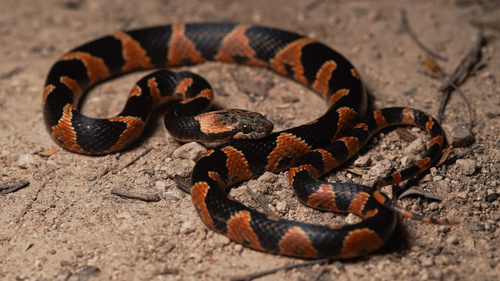
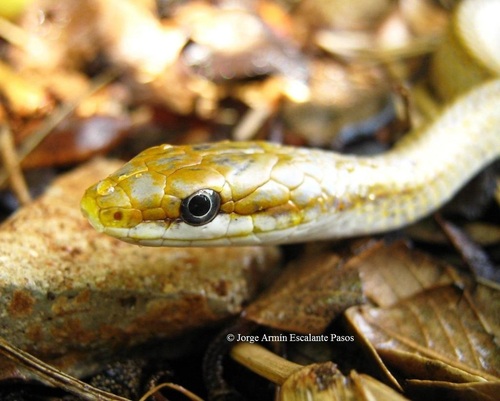
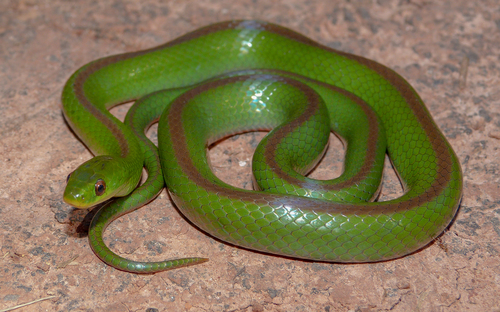
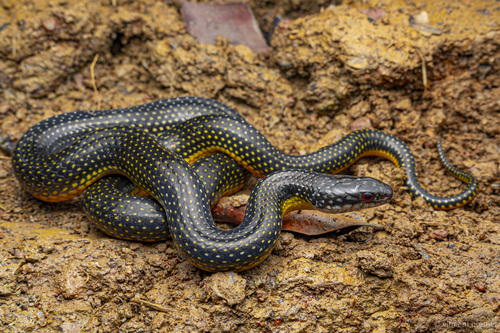
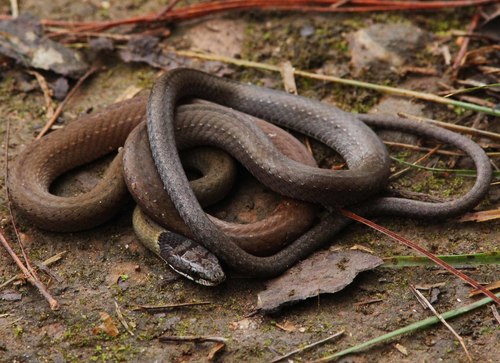
Scientific name: Sibynophis collaris (Gray, 1853). Scale description: The rostral scale is twice as broad as it is deep, and is just visible when viewed from above. The suture between the internasals is shorter than the suture between the prefrontals. The frontal scale is longer than its distance from the tip of the snout, and is as long as the parietal scales or shorter. The loreal scale is as long as, or a little longer than, it is deep. There is one preocular scale, and two postocular scales; only the upper postocular is in contact with the parietal. Temporal scale arrangement is 1 (or 2) + 2. There are 9 or 10 upper labial scales, with the fourth, fifth, and sixth entering the eye. Four lower labial scales are in contact with the anterior chin shields, which are the same length as the posterior chin shields. Dorsal scales are smooth, lack apical pits, and are arranged in 17 rows. There are 159–190 ventral scales; the anal scale is divided; subcaudal scales are divided, numbering 102–131. Color pattern: The upper side is brown, with the vertebral region greyish, and usually bears a series of small round black spots. The top of the head has small black spots or vermiculations, plus two black crossbands: one across the posterior portion of the frontal and supraocular scales, and the other across the occiput. There is a large black nuchal spot or crossband, which is bordered with yellow on its posterior edge. A black line runs from the nostril to the nuchal spot, passing through the eye and bordering the white upper lip that is dotted with black. The underparts are yellowish; each ventral scale has an outer black spot or streak, which may join together on the posterior portion of the body. Anterior ventral scales additionally have a pair of median black dots. Size: Total body length is 29 inches (737 mm); tail length is 9.5 inches (241 mm). Distribution: This species is found in Tehri Garhwal (Uttarakhand), Sub-Himalayan India (Assam, Simla), Mizoram, Bhutan, Nepal, Myanmar, Thailand, Laos, Vietnam, Cambodia, West Malaysia, China (southeastern Tibet and Yunnan), and Taiwan. The recorded occurrence on Jeju, the southernmost major island of South Korea, actually refers to Sibynophis chinensis. The type locality is Khasi Hills, India.