About Sibbaldia procumbens L.
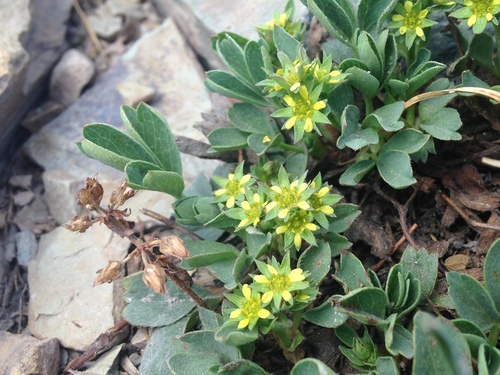
Sibbaldia procumbens, commonly called creeping sibbaldia, is a species of flowering plant in the genus Sibbaldia of the rose family. It has an Arctic–alpine distribution, found across the entire Arctic, as well as at high elevations in the mountains of Eurasia and North America. It grows on tundra, in alpine climates with year-round persistent snow, and on subalpine mountain slopes. This species is a low, mat-forming perennial herb that grows in clumps in rocky, gravelly substrate. A spreading stem up to 15 centimeters long grows from a caudex. Each leaf is typically divided into three leaflets, which are borne at the end of a petiole up to 7 centimeters long. Each wedge-shaped leaflet has three teeth at its tip. Its flower usually has five pointed green bractlets, five wider pointed green sepals, and five tiny yellowish petals each about one millimeter long. Fruits develop within the remaining sepal structures on erect stalks. This plant has an Arctic-alpine distribution with the following specific occurrences: in Europe, it grows in the Pyrenees, scattered sites in the Spanish Cantabrians and Sierra Nevada, the Alps, the French Vosges, Corsica, a small number of locations in the central Apennines, the Tatras on the Slovakia-Poland border, and Bulgaria's Rila and Pirin mountains. In northern Europe, it occurs in Scotland, the Faroe Islands, Iceland, Jan Mayen, Svaalbard, across the Scandinavian Mountains, northern Finland, the northern Urals, and along the Arctic coastline of European Russia from the Kola peninsula in the west to the Gulf of Ob in the east. It also grows across large areas of many Central Asian and South Siberian mountains, including the Tian Shan, Tarbagatay, Altai and Sayan ranges, and the Transbaikal highlands. Occurrences have also been recorded in the mountains of western China, including the provinces of Shaanxi, Sichuan and Yunnan, the Changbai Mountains on the border with Korea, the Japanese Alps, the island of Sakhalin, and isolated sites on the nearby Russian mainland. It is widely distributed in eastern Kamchatka, Chukotka, the Aleutian Islands, and parts of Alaska, then extends across the individual ranges of the North American Cordillera in western Canada and the United States. Its continuous range reaches its southern limits in the San Bernardino Mountains of California, the San Francisco Peaks of Arizona, and the Sangre de Cristo Mountains of New Mexico; the species reappears further south at high elevations in the Transvolcanic Belt of central Mexico. It also occurs in northeastern North America: in the White Mountains of New Hampshire, the Chic-Choc Mountains of Quebec's Gaspé region, and the Long Range Mountains of Newfoundland. It occurs more sporadically further north in Canada, along the coasts of northern Quebec and Labrador, in a few areas around Hudson Bay, and in southern Baffin Island. Finally, the species is also known from both the western and eastern coastal areas of Greenland.