About Sialia sialis (Linnaeus, 1758)
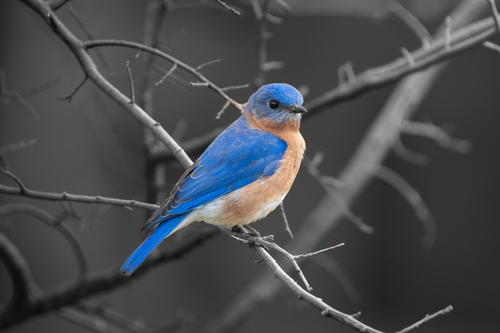
Eastern bluebirds (Sialia sialis) measure 16–21 cm (6.3–8.3 in) in length, have a wingspan of 25–32 cm (9.8–12.6 in), and weigh 27–34 g (0.95–1.20 oz). Males have bright blue coloring on their head, back, and wings, with a brownish red breast. Females are paler overall, with gray on the head and back and some blue on the wings and tail; their breast is typically lighter and more orange than males' breasts.
The eastern bluebird is distributed across areas east of the Rockies, ranging from southern Canada to the Gulf states, and from southeastern Arizona to Nicaragua. Over the past century, increased tree coverage across the Great Plains—caused by fire suppression and tree planting—enabled this species to expand its range westward, alongside many other bird species. From 1966 to 2015, the eastern bluebird population increased by more than 1.5% annually across most of its breeding and year-round ranges; the only exceptions are southern Florida and the Ohio River valley.
Eastern bluebirds occupy open country near trees, with minimal understory and sparse ground cover. Their original natural habitats likely included open, frequently burned pine savannas, beaver ponds, mature open woods, and forest openings. Today, they are most commonly found along pastures, agricultural fields, suburban parks, backyards, and even golf courses. Populations also occur across eastern North America and extend south as far as Nicaragua. Birds living further north and in the western part of the species' range tend to lay more eggs than birds in eastern and southern areas.
An isolated island subspecies of the eastern bluebird lives on Bermuda, and has a distinctive brighter blue coloration compared to mainland populations. This population was once thought to have been present on Bermuda before human colonization, which would make it one of only three living native land bird species that pre-dated colonization on the islands, alongside the Bermuda white-eyed vireo and gray catbird. However, analysis of fossil layers found no evidence of bluebirds living on the islands before European colonization. A 2013 study used simulations and molecular evidence to find that Bermuda's bluebirds likely descend from a very small founding population from a single colonization event in the 1600s. This colonization could have been natural, by migratory individuals, or an intentional introduction by early European settlers, who are documented to have introduced several other eastern North American bird species like the northern cardinal (Cardinalis cardinalis) to Bermuda very shortly after colonization. It is likely that alteration of Bermuda's ecosystem from clearing of native forest facilitated this colonization by creating optimal feeding habitat for bluebirds, combined with a lack of predators.
Eastern bluebirds are social, and will sometimes gather in flocks of over a hundred individuals. They are territorial during the breeding season, and may continue to defend a feeding area throughout the winter.
Around two thirds of an adult eastern bluebird's diet is made up of insects and other invertebrates, with the remaining third consisting of wild fruits or berries. They prefer to eat grasshoppers, crickets, katydids, and beetles; they will also consume earthworms, spiders, millipedes, centipedes, sowbugs, and snails. Bluebirds feed by perching on a high point such as a branch or fence post, then swooping down to catch insects on or near the ground. Whether an individual bluebird migrates often depends on the availability of winter food sources. If bluebirds stay in a region over winter, they gather in groups and seek cover in heavy thickets, orchards, or other areas that provide adequate food and cover resources.