About Sialia mexicana Swainson, 1832
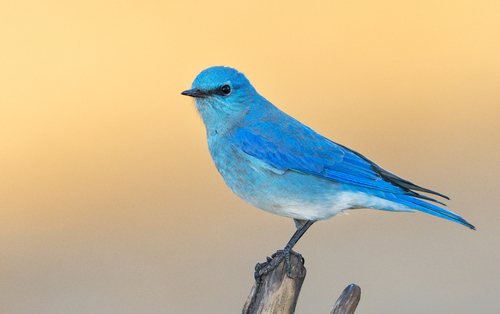
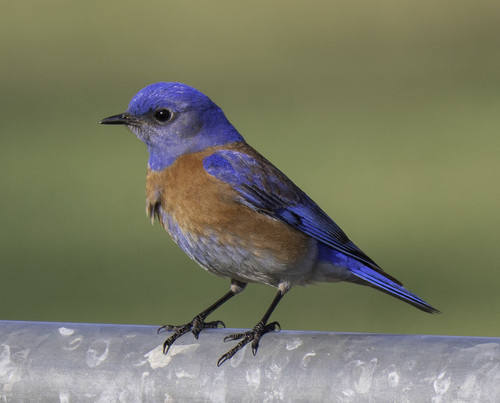
Sialia mexicana, commonly known as the western bluebird, is a small, stocky bird measuring 15 to 18 cm (5.9 to 7.1 inches) in length. Adult males have bright blue coloration on their upper body and throat, an orange breast and sides, a brownish patch on the back, and a gray belly and undertail coverts. Adult females have duller blue on their body, wings, and tail, paired with a gray throat, dull orange breast, and gray belly and undertail coverts. Both sexes share a thin straight bill and a fairly short tail. Immature western bluebirds have duller coloration than adults and have spots on their chest and back. Their vocalizations include mating calls that sound like "cheer," "chur-chur," and "chup." These calls help males locate females in dense forest, and males also use them to inform competing males that a territory is already claimed. The western bluebird can be easily told apart from the other two species in the bluebird genus: it has a blue throat in males and a gray throat in females, while the eastern bluebird (Sialia sialis) has an orange throat, and the mountain bluebird (Sialia currucoides) has no orange coloring anywhere on its body. Tree felling has displaced the western bluebird from its original natural habitat, but the species has adapted to survive in coniferous forests, farmlands, semi-open terrain, and desert. Its year-round range covers California, the southern Rocky Mountains, Arizona, and New Mexico in the United States, extending south as far as the Mexican states of Oaxaca and Veracruz. Its summer breeding range reaches north to the Pacific Northwest, British Columbia, and Montana. Northern populations of western bluebirds migrate to the southern parts of the species’ range, while southern populations are often permanent residents. When searching for food, western bluebirds pounce on the ground for prey such as worms and berries, and will also fly to catch aerial prey like insects when available. They typically wait on a perch, then fly down to catch insects, and sometimes catch insects midair. Their diet consists mainly of insects and berries. They get water from nearby streams and regularly use bird baths. They will also regularly visit bird feeders when mealworms or other insects are provided.