About Sherardia arvensis L.
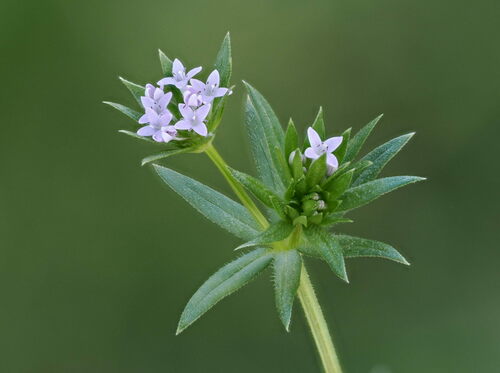
Sherardia arvensis L. is an annual plant with trailing and upright stems that reach up to 40 cm in length, and have a square cross-section. Its rough, pointed, bristly leaves are approximately 1 cm long, and grow in whorls of four to six; whorls normally contain six leaves at shoot ends, and four leaves closer to the root. The tiny pale lilac or pink flowers are around 3 mm in diameter, with a long tube, and only the end portion of the four petals is free. Flowers grow in clusters of two or three, held inside an involucral structure formed by a ring of six bracts. The fruits are dry, around 3 mm long, and have two lobes that each develop into a small, dry, indehiscent fruit called a nutlet. Its four-angled stems, whorls of bristly leaves, and tiny flowers resemble bedstraws and other related plants in the Rubiaceae family, but Sherardia arvensis can be distinguished by its mauve to pink clustered flowers with a long corolla tube. This species is hermaphroditic, and pollinated by flies. It is a common weed of fields, pastures, grassland, and disturbed areas. Although its dye quality is much lower than that of common madder (Rubia tinctorum), the fleshy roots of Sherardia arvensis are sometimes used to produce a red dye.