About Shepherdia argentea (Pursh) Nutt.
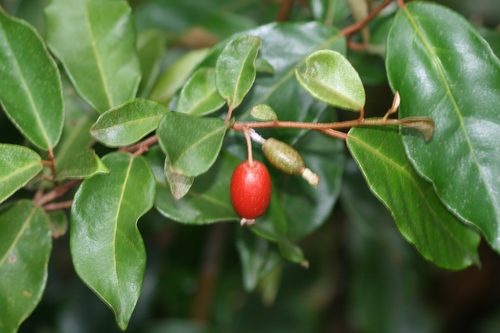
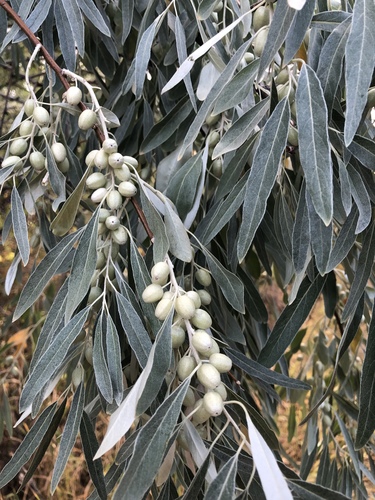
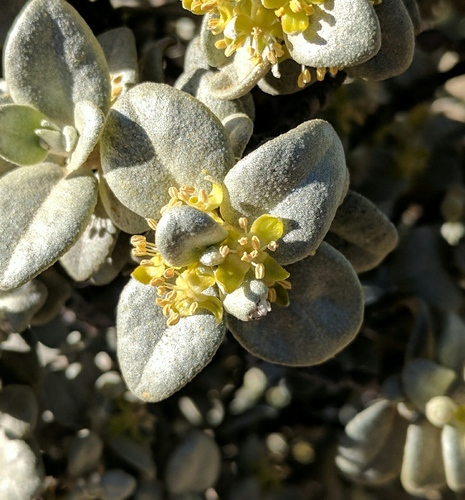
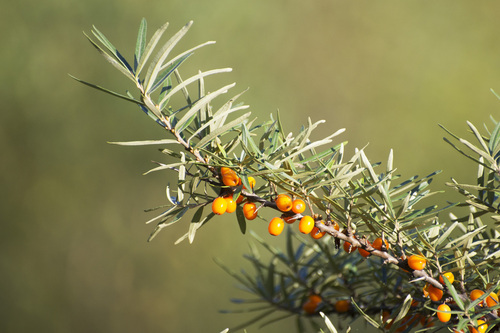
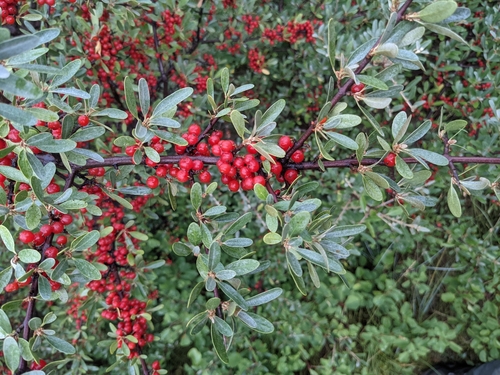
Shepherdia argentea (Pursh) Nutt. is a deciduous shrub that reaches 2–6 metres (6+1⁄2–19+1⁄2 ft) in height. Its leaves are arranged in opposite pairs, rarely alternate, and measure 2–6 centimetres (3⁄4–2+1⁄4 in) long. Leaves are oval with a rounded apex, and are green covered in fine silvery silky hairs, with thicker silver coloring on the underside than the upper side. The flowers are pale yellow, with four sepals and no petals. The fruit is a bright red fleshy drupe 5 mm in diameter; it is edible but has a rather bitter taste. Two cultivars, 'Xanthocarpa' and 'Goldeneye', produce yellow fruit. This species is native to central and western Canada and the United States, ranging from the Canadian Prairie Provinces of Alberta, Saskatchewan, and Manitoba south through the United States to Ventura County, California, as well as northern Arizona, and northwestern New Mexico. It grows in a wide variety of habitat types, including riparian areas, woodlands, exposed prairie slopes, and dry, sandy soils of plains and canyons. Its berries are a main dietary staple for sharp-tailed grouse, which is the provincial bird of Saskatchewan. Its foliage is an important forage source for mule deer and white-tailed deer. The shrub's thorny branches and thicket-forming growth habit provide shelter for many small animal species, and ideal nesting sites for songbirds. Across its range, buffaloberry is an important species for a variety of ecological communities. For example, it grows alongside many native grasses in the shrub-grassland communities of North Dakota, and occurs in green ash-dominated plant communities in the riparian woodlands of Montana and western North Dakota. Like the Canada buffaloberry, S. argentea has been used historically as food, for medicine, and for dye. Its documented uses include treatment for stomach troubles, and use in coming-of-age ceremonies for girls. In the Great Basin, the berries were eaten raw and dried for use in winter, but were more often cooked into a flavoring sauce for bison meat. Buffaloberry has been a staple food for some Native American groups, who consumed the berries in puddings, jellies, and raw or dried. The Gosiute Shoshone name for this plant is añ-ka-mo-do-nûp.