About Setophaga striata (J.R.Forster, 1772)
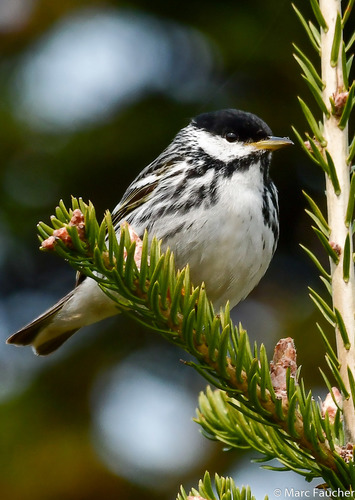
This species, the blackpoll warbler, has the scientific name Setophaga striata (J.R.Forster, 1772). It is a fairly small bird that weighs about as much as a ballpoint pen, and is one of the larger species in the diverse genus Setophaga, which was formerly called Dendroica. For this species, body length ranges from 12.5 to 15 cm (4.9 to 5.9 in), and wingspan ranges from 20 to 25 cm (7.9 to 9.8 in). Body mass can vary between 9.7 and 21 g (0.34 to 0.74 oz), with an average individual weighing 12 to 15 g (0.42 to 0.53 oz). Among standard body measurements, the wing chord is 6.6 to 8 cm (2.6 to 3.1 in), the tail is 4.5 to 5.4 cm (1.8 to 2.1 in), the bill is 0.8 to 1.2 cm (0.31 to 0.47 in), and the tarsus is 1.8 to 2 cm (0.71 to 0.79 in). Breeding summer male blackpoll warblers have dark-streaked brown backs, white faces, and black crowns. Their underparts are white with black streaks, and they have two white wing bars. Adult females look like faded, washed-out versions of summer males; specifically, females lack the bold strong head patterns, and their crowns and faces are different shades of gray. A distinct notable physical characteristic of this species is bright orangish-pink legs. Non-breeding blackpoll warblers have greenish heads, dark-streaked greenish upperparts, and yellowish breasts; in young birds, the yellow color extends to the belly. Wing bars are always present on individuals of this species. In terms of distribution and breeding habitat, in the southern part of their breeding range, blackpoll warblers live at higher mountain elevations, in woodland or brushy areas. They also spend their summer breeding season on the wooded coastal islands of Maine and the Maritime Provinces. Further north, the species has been recorded across the entire boreal coniferous forest. Blackpoll warblers breed closer to the tundra than any other type of warbler. In terms of behavior and ecology, even though it is fairly large for a warbler, the blackpoll warbler is often hard to spot. This is because of its relatively inactive foraging behavior, and its tendency to perch in dense foliage close to tree canopies. It is more often heard than seen, and its song is one of the highest-pitched songs known among birds. Its songs consist of simple repetitions of high tsi notes, while its calls are thin sits.