About Setophaga ruticilla (Linnaeus, 1758)
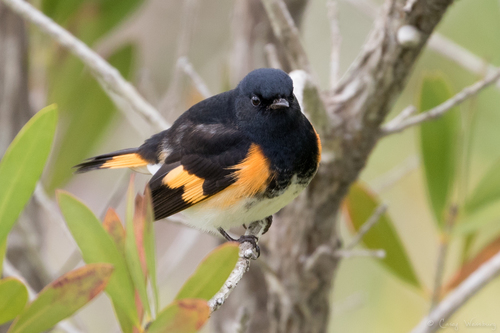
The American redstart (Setophaga ruticilla) is a relatively small New World warbler. It has a total length of 11 to 14 cm (4.3 to 5.5 in) and a wingspan of 16 to 23 cm (6.3 to 9.1 in). Its total length is increased by a proportionally long tail, and it is among the lightest members of its family. Individuals weigh considerably less in winter than they do in summer. On average, males weigh 8.6 g (0.30 oz) in summer and drop to 7.2 g (0.25 oz) in winter; females see a larger average weight change, going from 8.7 g (0.31 oz) in summer to 6.9 g (0.24 oz) in winter. Standard measurements for the species are as follows: wing chord 5.5 to 6.9 cm (2.2 to 2.7 in), tail 4.9 to 5.8 cm (1.9 to 2.3 in), bill 0.7 to 0.9 cm (0.28 to 0.35 in), and tarsus 1.5 to 1.9 cm (0.59 to 0.75 in). Breeding males have a distinct, easily recognizable appearance: they are jet black on their upperparts, aside from large orange-red patches on the wings and tail. Their breast sides are also orange, while the rest of their underparts are white. American redstarts that are not in breeding male plumage have green upperparts, black central tail sections, and grey heads. In females and young birds, the orange patches seen on breeding males are replaced with yellow patches. This difference in orange and yellow coloration comes from different carotenoid pigments: males have the red carotenoid canthaxanthin plus yellow carotenoids canary xanthophyll A and B, which mix to create an orange color, while females only have yellow carotenoids. Recent research has found that age and sex affect the observed color attributes of hue, brightness, and saturation in American redstarts; only saturation showed an effect limited to age, with no observed sex effect. The song of the American redstart is a series of musical see notes, and its call is a soft chip. While it may be less common now than it once was, the American redstart is one of the most stable and abundant New World warbler species. Only the common yellowthroat, yellow warbler, and yellow-rumped warbler have larger total population numbers, due to their much wider natural breeding ranges; within suitable habitat, American redstart density may be higher than these three species. The species breeds in North America, across southern Canada and the eastern United States. It is migratory, wintering in Central America, the West Indies, and northern South America, and is a very rare vagrant to western Europe. During the breeding season, American redstarts live in open-canopy, mostly deciduous forests, second growth, and forest edges. They are insectivorous, often share foraging habitat with other warblers, and feed in the mid to lower sections of trees and shrubs. They use a wide variety of habitats during migration, including many shrubby areas. On wintering grounds in Central and South America, American redstarts can be found in almost all woody habitats, but tend to avoid non-forested agricultural areas. They are often found in shade-grown coffee plantations, which provide native trees and shrubs alongside coffee trees. The elevation range they occupy varies by location: they can be found up to 3,000 m (9,800 ft) in South America, but only up to 1,500 m (4,900 ft) in Jamaica.