About Setophaga pensylvanica (Linnaeus, 1766)
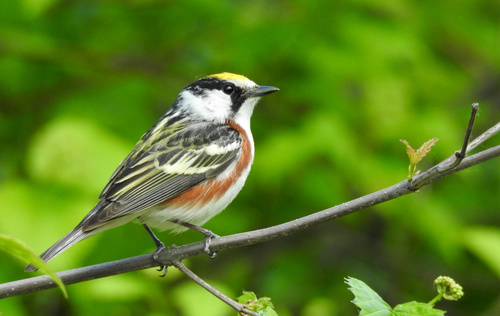
This species, the chestnut-sided warbler, is a moderately sized New World warbler. Though the two have very different plumage, it is thought to be closely related to the widespread yellow warbler. This species measures 10 to 14 cm (3.9 to 5.5 in) in total length, with a wingspan of 16 to 21 cm (6.3 to 8.3 in). Its body weight ranges from 8 to 13.1 g (0.28 to 0.46 oz). Among standard measurements, the wing chord is 5.7 to 6.8 cm (2.2 to 2.7 in), the tail is 4.2 to 5.8 cm (1.7 to 2.3 in), the bill is 0.9 to 1 cm (0.35 to 0.39 in), and the tarsus is 1.7 to 1.9 cm (0.67 to 0.75 in). In summer breeding plumage, male chestnut-sided warblers have a distinct, unmistakable appearance: they have dark-streaked gray backs, white faces, black eyestripes, yellow crowns, white underparts, chestnut-colored flanks, and two white wing bars. Adult females look like faded, washed-out versions of summer males; they lack the strong distinct head pattern of males, and have little to no chestnut coloring on their flanks. Non-breeding birds of both sexes have bright yellow-green crowns, white eye-rings on a gray face, and completely unstreaked underparts and pale gray unstreaked breasts. Wing bars are always present in this species' plumage at all life and seasonal stages. Chestnut-sided warblers breed in Eastern North America, ranging from Saskatchewan to the Maritimes. One observation of a breeding-plumage male has been recorded as far west as British Columbia. Breeding populations are usually found south of 50°N latitude, with the southernmost extent of their breeding range located in northwestern Georgia. This species overwinters from Central America to northern Colombia, with one confirmed sighting recorded as far south as Ecuador. Most non-breeding individuals overwinter in Central America, with the highest population concentrations found in Costa Rica; small numbers also overwinter in southern Mexico and parts of northwestern South America. The chestnut-sided warbler has benefited from the clearing of mature forests across its breeding range. It readily uses abundant second-growth habitats, including areas regenerating after clearcutting or wildfire. Local population numbers increase as early as one year after clearcut disturbance, and peak between seven and eight years after the disturbance. During the winter non-breeding season in the tropics, the species mostly occurs in mature tropical rainforests, where it tends to stay in the mid to upper canopy. In Costa Rica, it has also been recorded using coffee plantations and riparian zones. Chestnut-sided warblers are primarily insectivorous. They feed mainly on lepidopteran and dipteran larvae, and will sometimes eat spiders, seeds, and fruits. They forage actively in shrubs and small trees, and will occasionally attempt to catch insects in mid-air. Most foraging activity involves gleaning insects directly from foliage. During the winter, they add berries to their diet, including berries from Cymbopetalum mayanum; these trees can be used to attract wintering chestnut-sided warblers to gardens and parks. Chestnut-sided warblers forage alone.