About Setophaga palmarum (J.F.Gmelin, 1789)
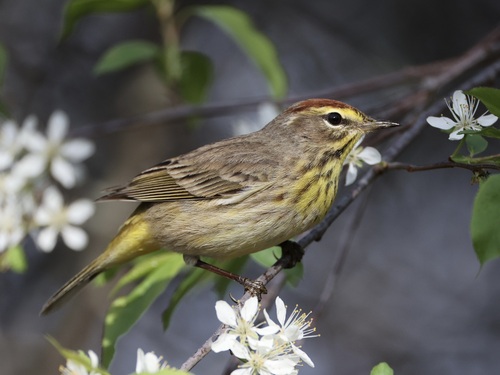
This species, the palm warbler, has the scientific name Setophaga palmarum (J.F.Gmelin, 1789). It has a body length of 12 to 14 centimeters (4.7 to 5.5 inches), a wingspan of 20 to 21 centimeters (7.9 to 8.3 inches), and a body weight ranging from 8.5 to 14.2 grams (0.30 to 0.50 ounces). Palm warblers breed in open coniferous bogs and their edges east of the Continental Divide, across Canada and the northeastern United States. These birds migrate to the southeastern United States, the Yucatán Peninsula, islands of the Caribbean, and areas from eastern Nicaragua south to Panama to spend the winter. They are one of the earliest migratory warblers to return to their breeding grounds in spring, often finishing their migration almost two months earlier than most other warbler species. Unlike most other species in the Setophaga genus, the palm warbler's winter range covers a large portion of North America's Atlantic coast, and extends as far north as southern Nova Scotia. Every year since 1900, the palm warbler has been observed during Christmas Bird Count activities in Massachusetts, and has been consistently observed during these activities in Nova Scotia since 1958. Over the 1966–2015 interval, the palm warbler population grew across most of its northernmost breeding range. The palm warbler has been recorded as a vagrant individual in Iceland.