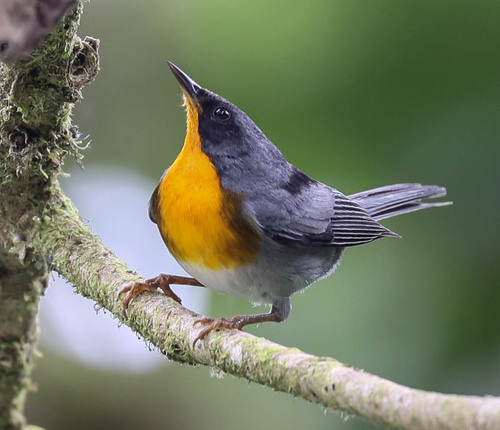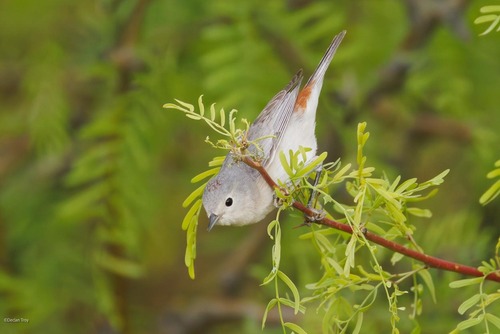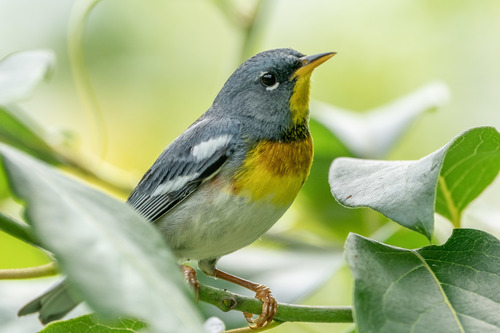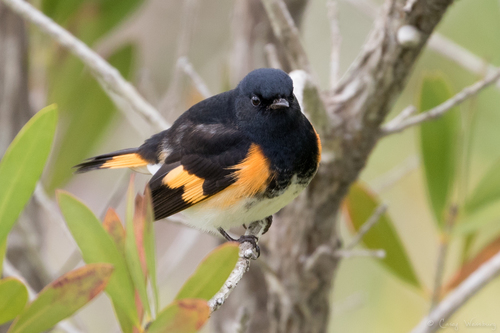
About Setophaga kirtlandii (S.F.Baird, 1852)
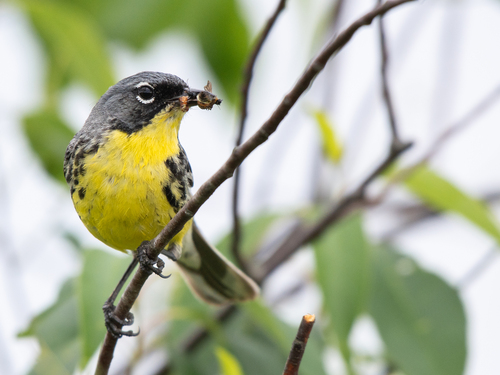
Description: Male Kirtland's warblers have bluish-grey upper bodies, with dark streaks on the back, yellow bellies, and dark streaks on the flanks and sides. They have black lores (cheeks) and a distinctive, large, conspicuous broken white eye ring, a trait only shared with Setophaga coronata. Females and juveniles have a similar pattern, but their wings and back are browner, and their markings are less bold and bright. Kirtland's warblers frequently bob their tails up and down, a behavior that is uncommon among northern warblers. Measuring 14–15 cm (5.5–5.9 in) long and weighing 12.3–16 g (0.43–0.56 oz), this species is the largest of the many warblers formerly classified in the genus Dendroica, and remains the largest of the roughly 35 species currently placed in the accepted Setophaga genus. Kirtland's warblers have a wingspan of 22 cm (8.7 in). The species' mating song is a loud chip-chip-chip-too-too-weet-weet, often sung from the top of a snag (dead tree) or a clump of northern pin oak (Quercus ellipsoidalis). This song can be heard over 400 meters away in good conditions. On overwintering grounds, the species does not sing, but produces loud "chip" calls from low within dense bushes. Fresh Kirtland's warbler eggs are a delicate pinkish white, fading to dull white over time. Eggs have a few scattered speckles in various shades of brown and pink, with these markings concentrated at the larger end, where they often form a wreath-like shape. Eggs are not very glossy, measure 18 by 14 mm, and have a very thin shell. Distribution: Kirtland's warbler was originally only known from Ohio, the home state of the namesake Kirtland. By the mid 20th century, the species' breeding range had been reduced to a very limited area in the north of Michigan's Lower Peninsula. As the population has expanded in recent years, breeding pairs have also been found in Michigan's Upper Peninsula, Wisconsin, and southern Ontario. The birds winter in Cuba, The Bahamas, and the nearby Turks and Caicos Islands, where they have been found on all investigated islands. A number of individuals also overwinter on Hispaniola, in the Dominican Republic. Overwintering birds have been repeatedly collected and sighted in Florida. The species has been recorded as a rare accidental visitor to Bermuda and Jamaica, and there is an uncorroborated report from coastal Mexico. It has also been observed in summer in Québec, although there is no evidence it breeds there. First-time migrants travel west from The Bahamas to Florida and South Carolina from the second half of April to early May. From there, they move further northwest and west until they reach the Mississippi River, which they then follow upstream to the mouth of the Ohio River during May. They reach their breeding grounds in early June, and leave the breeding range between August and October. Habitat: On their wintering grounds, Kirtland's warblers are found primarily in low "coppice" habitat, especially areas cleared for slash-and-burn agriculture that have regrown after abandonment, which accounts for 98% of all winter records. They prefer dense shrubbery with occasional small openings, no canopy, and low ground cover. Outside of this primary habitat, they have been found in all other island habitats, albeit uncommonly, including suburban gardens and Bahamian pineyards. They have never been observed in uncut high coppice. With rare exceptions, 98% of winter sightings occur from ground level up to 3 meters high. For breeding, the species requires large areas of young jack pine growing on sandy soil. Kirtland's warblers reach their highest numbers in large areas that have been clear cut or hit by large wildfires. Breeding sites require stands of jack pine that are 6 to 20 years old and 2–4 meters high. Common companion plants in this breeding habitat include blueberry (Vaccinium angustifolium), sweet fern (Comptonia peregrina), Canada mayflower (Maianthemum canadense), and various grasses. While the species was initially thought to only breed in jack pine stands, newer research has found that Kirtland's warblers will also breed in some locations in young 10 to 15 year old red pine (Pinus resinosa) stands. When pine stands grow tall enough to lose their lowest branches near the forest floor, the habitat no longer provides sufficient cover for breeding. Ideal breeding stands are densely stocked with young pines, but also have occasional small patches of open or sparsely treed area. Ecology: The Kirtland's warbler's summer breeding habitat, where the bird lays its eggs and raises its young, is in northern Michigan. Kirtland's warblers only build their nests on the ground, in young jack pine forests in Michigan and sometimes Wisconsin.