About Setophaga fusca (Statius Müller, 1776)
The Blackburnian warbler, with the scientific name Setophaga fusca (Statius Müller, 1776), is a small passerine and average-sized wood-warbler. It measures 11 to 13 cm (4.3 to 5.1 in) long, has a 20 to 22 cm (7.9 to 8.7 in) wingspan, and weighs 8 to 13 g (0.28 to 0.46 oz). The average mass of an adult Blackburnian warbler is 9.7 g (0.34 oz); mass is slightly higher in fall due to fat reserves, averaging 10.2–10.4 g (0.36–0.37 oz). Standard body measurements are as follows: wing chord 6.3 to 7.3 cm (2.5 to 2.9 in), tail 4.2 to 5 cm (1.7 to 2.0 in), bill 0.9 to 1 cm (0.35 to 0.39 in), and tarsus 1.6 to 1.8 cm (0.63 to 0.71 in).
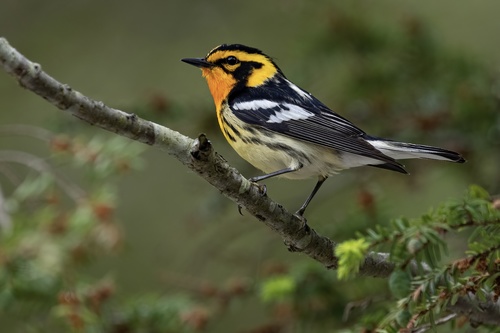
In summer breeding plumage, male Blackburnian warblers have dark gray backs, double white wing bars, yellowish rumps, and dark brown crowns. Their underparts are white, tinged with yellow and streaked black, and their heads have a strong yellow and black pattern with a bright flaming-orange throat. This is the only North American warbler with this distinctive plumage pattern. Other plumages, including those of fall males and adult females, are paler washed-out versions of the summer male plumage, and specifically lack the bright colors and strong head pattern. Even females are practically unmistakable when seen clearly, thanks to their dull-yellow supercilium that contrasts with greyish cheeks, and yellow throat that contrasts with dark streaky sides and back. The only other wood-warbler with an orange throat is the Central American flame-throated warbler, which is very distinct, lacking the blackish head streaking and whitish underside seen in male Blackburnian warblers. Basic plumages have paler yellows, with gray replacing the black found on breeding males.
Blackburnian warbler songs are simple sequences of high, thin "swi" notes that often rise in pitch. Common song transliterations include zip zip zip zip zip zip zip zip, titititi tseeeeee, or teetsa teetsa teetsa teetsa. Their call is a high sip. Genetic research shows that the closest living relative of the Blackburnian warbler is the bay-breasted warbler, which may be specialized to forage at lower levels within the same coniferous trees. Wild hybridization has been recorded once each with a bay-breasted warbler in West Virginia, and with a black-and-white warbler in Pennsylvania. A possible wintering hybrid with a Kirtland's warbler has been documented in Hispaniola.
Blackburnian warblers are solitary during winter, and highly territorial on their breeding grounds, and do not mix with other passerine species outside of the migratory period. During migration, they often join local mixed foraging flocks that include species like chickadees, kinglets, and nuthatches. In the tropics, they are fairly social during migration but remain solitary from other passerines while wintering. These birds are primarily insectivorous, but add berries to their diet during winter. They typically forage by searching for insects or spiders in treetops. Their breeding season diet is dominated by Lepidoptera (moth and butterfly) larvae. During spruce budworm breakouts, they can help control this pest at a local level, even if not at the epidemic level. One study conducted in Ontario found that 98% of the species' diet was insects, with the remaining 2% being spiders. Among migratory Setophaga warblers, the Blackburnian warbler is considered a specialist foraging in the top canopy micro-habitat of trees.
The species' breeding habitat is mature coniferous woodland, with the core of its breeding range located in the southeastern portion of Canada's boreal forest. Its breeding distribution extends broadly through most of New England and the Appalachian Mountains, from New York to the northernmost tip of Georgia, where it occurs in elevated mixed woodlands, especially those that contain spruce and hemlocks. In mixed forests, hemlocks are the most likely tree to host Blackburnian warblers. The species typically winters in tropical montane forests at elevations from roughly 600 to 2,500 m (2,000 to 8,200 ft), mainly from Colombia to Peru, with more scattered occurrences in Panama and the Amazon region.
Blackburnian warblers lay their first clutch between mid-May and early June in the contiguous United States, and 1 to 2 weeks later in Quebec. They build an open cup nest made of twigs, bark, plant fibers, and rootlets, secured to a branch with spider web, and lined with lichens, moss, hair, and dead pine needles. The nest is placed near the end of a horizontal branch, typically 2–38 m (6.6–124.7 ft) above the ground. Though the species usually raises only one brood per year, it can produce a second or even third brood if the first nest is destroyed. Three to five whitish eggs are laid. Occasional unusual materials found in nests include string, willow cotton, horsehair, and cattail down. Only the female broods, and she spends approximately 80% of each day actively brooding; the male usually helps bring food to the nest.
Among warblers, Blackburnian warbler nests are relatively rarely parasitized by brown-headed cowbirds, most likely because cowbirds do not succeed well in dense pine-dominated forests. Blue jays and American red squirrels have been confirmed to prey on nestlings and newly fledged young, and a merlin has been recorded killing a brooding adult female. Sharp-shinned hawks and Cooper's hawks are suspected, but not confirmed, predators of adult Blackburnian warblers. The single greatest threat to this species is forest habitat destruction; some predictions estimate the species could lose more than 30% of its total wintering or breeding habitat. Currently, however, the species occurs over a large range and maintains stable numbers in areas with appropriate habitat.