About Setophaga dominica (Linnaeus, 1766)
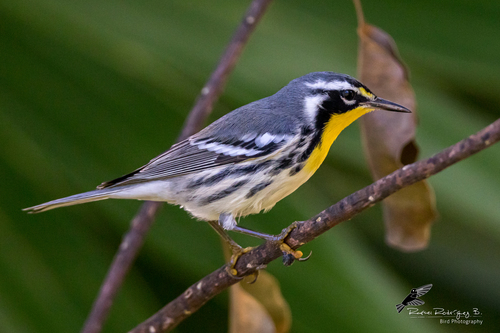
The yellow-throated warbler (Setophaga dominica) measures 13–14 cm (5.1–5.5 in) in length, has a 21 cm (8.3 in) wingspan, and weighs 8.5–11.3 g (0.30–0.40 oz). In summer breeding plumage, males have gray upperparts and wings marked with two distinct white wing bars. They have a yellow throat, white underparts with black streaking along the flanks, and a bold black-and-white head pattern with a long supercilium. Their flight feathers (remiges) and tail feathers (rectrices) are black. Females, immature individuals, and non-breeding males resemble paler, less defined versions of summer males; they have a less crisp head pattern, duller yellow throat color, and dark gray body plumage instead of black. Sexual dimorphism in this species is slight compared to most other New World warblers. Males produce clear, descending whistles as their song. Their calls are either high thin sees or sharp chips. These birds breed in southeastern North America, with their breeding range stretching from southern Pennsylvania and northern Missouri down to the Gulf of Mexico. One subspecies native to northwest Florida remains resident year-round. All other populations are migratory, and winter along the Gulf Coast, in eastern Central America, and in the Caribbean. Vagrant wintering individuals are occasionally observed in the northernmost part of South America. Compared to other Setophaga warblers, this species has a different range pattern: it has a much larger resident population in the southern United States than other warblers in the genus, its breeding range extends further south, and its wintering range extends further north than other members of Setophaga. McKay et al. note that the near absence of this species from the lower Piedmont of the Carolinas and Georgia is a currently unexplained pattern. Yellow-throated warblers are woodland birds, and they prefer to nest in coniferous or swamp tree species. They are primarily insectivorous, but add a substantial amount of berries and nectar to their diet when they are not breeding. They typically pick food directly from tree branches, but will catch flying insects in a brief hovering flight.