About Setophaga coronata (Linnaeus, 1766)
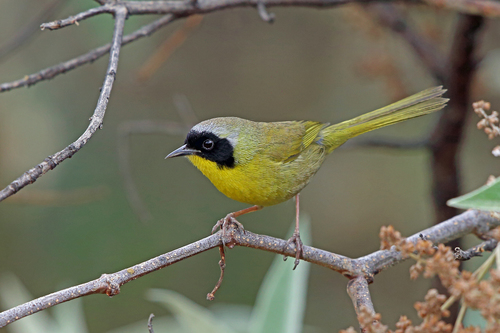
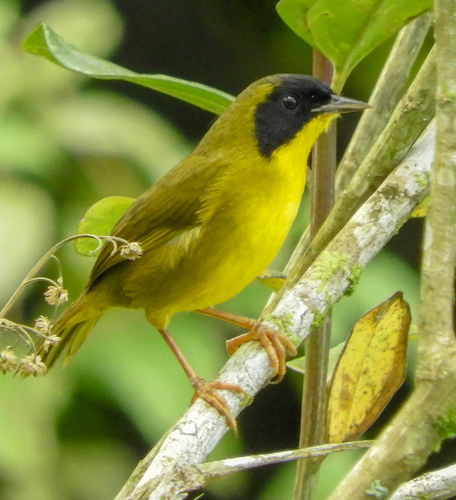
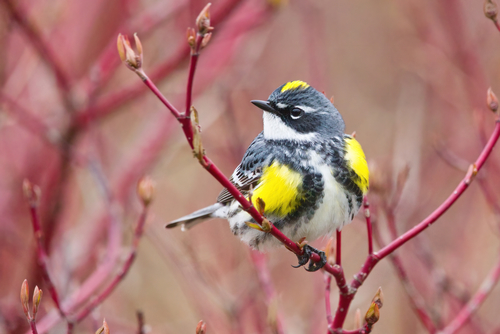
This species, commonly called the yellow-rumped warbler, has an average length of 14 cm and an average weight of 12.5 g. Appearance differs noticeably across its subspecies groups, especially the two major groups: the coronata group (myrtle warbler) and the auduboni group (Audubon's warbler), with additional variation within each group. Despite these differences, all subspecies have a distinct yellow rump, the trait that gives the species its common name. For myrtle warblers in the breeding season, adult males have gray backs with dark streaks, while adult females have contrasting brown backs. The two sexes can also be told apart by cheek color: males have black cheeks, and females have brown or gray cheeks. Audubon's warbler is very similar to myrtle warbler. In summer, breeding males of both subspecies groups have streaked black-on-slate-blue backs, white wing patches, a streaked breast, and obvious yellow patches on the crown, flank, and rump. The yellow rump gives the species the birdwatcher nickname "butter butt". The two groups can be distinguished by throat patch color: Audubon's warbler has a yellow throat patch, while myrtle warbler has a white throat, a white eye stripe, and a contrasting black cheek patch. Females of both groups have duller plumage, with brown streaking on the front and back, but still have clearly visible yellow rumps. Goldman's warbler, a subspecies found in Guatemala, resembles Audubon's warbler, but has a white lower border on its yellow throat and overall darker plumage; breeding males have entirely black backs instead of Audubon's slate blue. Within the genus Setophaga (formerly classified as Dendroica), which makes up most of the New World warbler family, the yellow-rumped warbler is a mid-to-large species. Its total length ranges from 12 to 15 cm (4.7 to 5.9 in), and its wingspan ranges from 19 to 24 cm (7.5 to 9.4 in). While its length is only slightly greater than other Setophaga warblers, it is mildly to significantly heavier than most other North American Setophaga species; only blackpoll warblers are slightly larger. Body mass ranges from 9.9 to 17.7 g (0.35 to 0.62 oz), with an average between 11 and 14 g (0.39 to 0.49 oz). Standard measurements are as follows: wing chord 6.3 to 8.4 cm (2.5 to 3.3 in), tail 5 to 6.6 cm (2.0 to 2.6 in), bill 0.8 to 1.1 cm (0.31 to 0.43 in), and tarsus 1.8 to 2.2 cm (0.71 to 0.87 in).
The yellow-rumped warbler breeds across North America from the eastern coast west to the Pacific, and extends south into western Mexico. Two non-migratory endemic subspecies exist: Goldman's yellow-rumped warbler is restricted to the highlands of Guatemala, and the black-fronted warbler is a non-migratory endemic of Mexico. The myrtle and Audubon's forms are migratory, and winter in the southern United States, Mexico, Central America, and the Caribbean. The myrtle warbler breeding range stretches from Alaska across Canada to Newfoundland, reaching as far south as Massachusetts, the mountains of Virginia, and the entire northern Great Lakes region. Myrtle warblers migrate south for the winter, with their winter range extending from southern British Columbia all the way to Panama, and covering most of the southeastern United States. Audubon's warbler breeds throughout western North America, from British Columbia to California, across the Rocky Mountains and as far east as the Dakotas. Among North American warblers, Audubon's warbler has the most widespread winter range, and is among the last migrants to leave breeding grounds in fall and among the first to return in spring.
During the breeding season, yellow-rumped warblers generally occupy either exclusively coniferous areas across the North American continent, or mixed coniferous-deciduous habitats where coniferous forests merge with trees such as aspen (Populus spp.) and willow (Salix spp.). Most breeding habitats in the western United States are mountainous, but the species can also live at sea level as long as conifers are present, which is the case in the Pacific Northwest and the New England region of the United States. Research shows that yellow-rumped warblers are generally adaptable to changes in breeding habitat tree density caused by selective logging: population densities remain largely unchanged in areas where logging reduces tree density. The species can maintain breeding population densities as long as some mature trees, used for nesting, remain. Nests of the Audubon's warbler group are shaped like a deep cup. The nest frame is built from twigs, bark, and fiber, and the outer rim of the cup is woven with softer materials including grass, hair, and feathers. This structure conceals eggs from predators when parent warblers are away from the nest.
During the non-breeding winter season, yellow-rumped warblers most often occupy open areas with shrubs or scattered trees that provide food sources such as bayberries or insects. Preferred open areas include agricultural land, residential areas, secondary forests, and shrublands, all of which have relatively low vegetation density. The species can also live in relatively open forests including mangroves and pine forests, and even in coffee plantations. During migration, yellow-rumped warblers use a wider variety of habitats than in breeding or winter seasons. While they are sometimes found in the deserts of the American southwest, they are more common in alpine areas during migration, and tend to avoid arid lowlands.