About Setophaga chrysoparia (P.L.Sclater & Salvin, 1860)
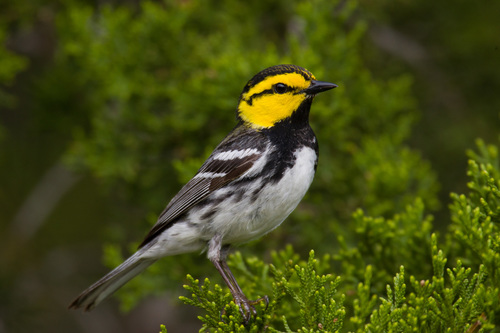
The golden-cheeked warbler (Setophaga chrysoparia) is a striking bird, easily recognized by its bright yellow cheeks that contrast sharply with its black throat and back. It can also be identified by its unique buzzing song, which comes from the wooded canyons where it breeds. This warbler breeds across 33 counties in central Texas, and it depends on ashe juniper, also called blueberry juniper or cedar, to obtain fine bark strips that it uses as nesting material. The golden-cheeked warbler is endemic to Texas and Mexico, and it can be found in numerous Texas state parks and protected areas, including Colorado Bend State Park (SP), Dinosaur Valley SP, Garner SP, Guadalupe River SP, Honey Creek State Natural Area (SNA), Hill Country SNA, Kerr Management Area, Longhorn Cavern SNA, Lost Maples SNA, Meridian SP, Pedernales Falls SP, Possum Kingdom SP, and South Llano River SP. Its habitat spans from moist to dry areas across central and southern Texas. In moister regions, its nesting habitat occurs in tall, closed-canopy, dense, mature stands of ashe juniper (Juniperus ashei) mixed with Texas oak, shin oak, live oak, lacey oak, and post oak trees. In drier parts of Texas, the species lives in upland juniper-oak woodlands on non-flat topography. Golden-cheeked warblers build their nests from ashe juniper bark and spider webs. Females lay three to four eggs per clutch. During migration and winter, they occupy a similar type of habitat: a range of short-lived evergreen pine forests between 3,300 and 8,300 feet in elevation. This species breeds in juniper-oak woodlands. Nest building typically begins around the end of March, with nests placed 16–23 feet above ground, constructed primarily from ashe juniper bark. Males use song and physical aggression against other males to establish a territory near the territory they held the previous year. Golden-cheeked warblers are monogamous for the full duration of the breeding season. The female lays 3–4 white eggs marked with brown and purple spots. These eggs hatch after 10–12 days of incubation. Hatchlings grow quickly and leave the nest 9–12 days after hatching. The entire family will remain together on their territory for up to a month, after which the young warblers become independent.