About Setophaga cerulea (A.Wilson, 1810)
This section describes the physical characteristics of the cerulean warbler (Setophaga cerulea). It is one of the smallest species of Setophaga wood-warblers, with an approximate length of 11 cm (4.3 in), a weight of 8–10 g (0.28–0.35 oz), and a wingspan of 20 cm (7.9 in). Males are slightly larger than females, and older males tend to be larger than younger males. Measurements for specific body parts are as follows: wing chord is 62–66 mm (2.4–2.6 in), tail length is 40.6–42.7 mm (1.60–1.68 in), and the culmen (the upper edge of the beak) measures 9.5–9.8 mm (0.37–0.39 in) long, 3.5 mm (0.14 in) wide, and 3.5 mm (0.14 in) high.
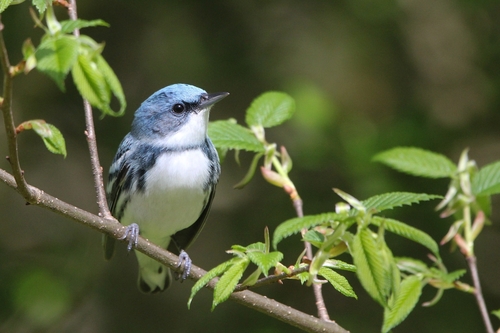
The species shows strong sexual dichromatism. Adult males have deep cerulean blue across their entire back, white underparts, prominent dark streaks along their flanks, and a blue to near-black breast band (also called a "necklace") that crosses the neck. Older individuals have stronger overall body coloration, including brighter white areas, darker streaks, and wider breast bands. Adult females have yellow underparts, and a blue-green tint on the back and crown. Females also have a distinct pale supercilium, or eye stripe, located just above the eye. Immature individuals are generally similar in appearance to adult females, but their backs may be more yellowish. All fledged cerulean warblers, regardless of age or sex, have two prominent white wing bars and white spots on the tail.
Beak and leg color varies by age and sex. Adult males have a black beak, with the lower half a slightly lighter dark gray. Adult females have dark gray beaks, which may become dark brown on the lower half. Recently fledged birds have brownish beaks. Adult cerulean warblers have black legs and brown irises, while juveniles have dark brown legs and dark brown irises. Hatchlings have pink bare parts (including the beak and legs) and black eyes.
The song of the cerulean warbler is a buzzed, accelerating sequence of zray zray zray zray zeeee. Its primary call is a buzzy, metallic zzee. Males use their song to attract potential mates and to mark their territory. The species can imitate the songs of other birds in addition to producing its typical song. Females rarely sing, but they often call while nesting. They use an alarm call to signal the arrival of a predator or another bird that threatens the nest.
This section outlines the distribution and habitat of the cerulean warbler. Its preferred summer habitat is large, unfragmented mature deciduous hardwood forest. It nests in the upper canopy, often at heights above 30 m (98 ft), and individual territories are typically around 2 ha (4.9 acres) in size. It forages throughout the mid to high canopy. Generally, a forested area of over 700 ha (1,700 acres) is required to support a cerulean warbler population. The species commonly selects riparian areas.
Its breeding range extends from southern Tennessee to southern Ontario, bounded by the Atlantic Ocean to the east and the Great Plains to the west. The majority of the population breeds in the forests of the Appalachian Mountains, with smaller numbers found in forests across the United States and Canada. Historically, the cerulean warbler was common to abundant as far south as Alabama and Mississippi, but habitat loss in these southern regions has shifted the center of its breeding range northward.
The cerulean warbler migrates more than 5,000 km (3,100 mi) between its breeding and non-breeding ranges. In spring, it follows an overland route through Central America, only crossing water to pass over the Gulf of Mexico at the Yucatán Peninsula. In autumn, it may fly over the Caribbean Sea, traveling from Florida to Cuba before continuing to continental South America. Migration takes 40 to 70 days total, most of which is spent at stopover sites where birds stay at a single location for 2 to 18 days.
Its non-breeding range covers a broad area of northern South America, and extends south along the Andes Mountains. Individuals have been found as far south as Bolivia, while in the north the species is often found throughout Colombia and Venezuela. The cerulean warbler prefers tall forest, so its presence is strongly correlated with old-growth subtropical forests or shade coffee plantations. In its non-breeding range, it occurs at altitudes between 500 m (1,600 ft) and 2,000 m (6,600 ft).
The cerulean warbler has been recorded as a vagrant in Iceland. One individual has also been recorded in Florianópolis, far southeast Brazil, which is more than 2,500 km (1,600 mi) outside of the species' normal wintering range.