About Setophaga castanea (A.Wilson, 1810)
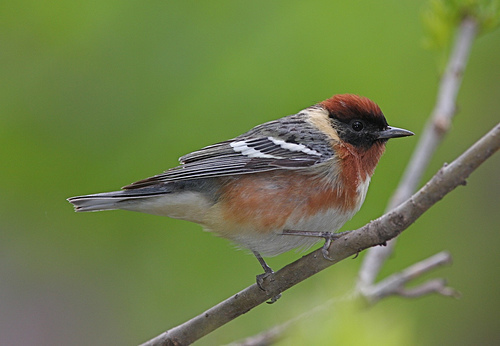
The bay-breasted warbler has the scientific name Setophaga castanea (A.Wilson, 1810). In breeding plumage, adult males are primarily greyish on their upperparts, with two distinct white wing bars, dark streaks across the back, and a creamy patch on the neck. Their face is solid black, while their crown, throat, and sides are a dark chestnut color. Breeding females follow the same overall pattern as breeding males, but their plumage is paler and duller. During the nonbreeding season, both sexes grow new olive-green feathers across the back, nape, and head. The rufous coloring on the flanks is reduced in nonbreeding birds, and may disappear completely in nonbreeding females. Two white wing bars are present in every plumage of the species. In breeding plumage, the bay-breasted warbler can be confused with the closely related chestnut-sided warbler (Setophaga pensylvanica), which also has chestnut coloring on its sides. The two species are easily distinguished by how far the chestnut coloring extends: on chestnut-sided warblers, the chestnut does not reach the throat or crown. Breeding plumage chestnut-sided warblers also have a bright yellow crown, a dark face mask, and white cheeks and throat. In fall, nonbreeding bay-breasted warblers can look very similar to nonbreeding blackpoll warblers (Setophaga striata). However, blackpoll warblers never show any chestnut coloring on their flanks, and also have yellowish feet, unlike the black feet of bay-breasted warblers. Bay-breasted warblers breed in boreal spruce-fir forests of eastern and central Canada, ranging from Newfoundland west to northeastern British Columbia, as well as in the far northeastern United States. The species spends the winter in wet lowland forests of northeastern South America, the Caribbean, and southern Central America. It can be observed during spring and fall migration across the eastern half of the United States, in a wide variety of vegetative communities. Many individuals cross the Gulf of Mexico during their long-distance migration, though some travel north and south along the Mexican coast instead. It is a rare vagrant as far west as the west coast of North America, and has also been recorded in Greenland. During the breeding season, bay-breasted warblers feed primarily on insects and spiders, especially spruce budworm (Choristoneura fumiferana). They glean this prey from vegetation, and never catch prey in flight. To avoid competition with other similar warbler species, bay-breasted warblers on breeding grounds focus their foraging on the interior middle sections of coniferous trees. On tropical wintering grounds, fruit makes up the majority of their diet. Wintering bay-breasted warblers often join mixed-species foraging flocks with other neotropical migrants and resident bird species. These flocks search for food in the forest canopy, and bay-breasted warblers are often aggressive members of the flock, bullying smaller species away from potential food sources.