About Setina irrorella (Linnaeus, 1758)
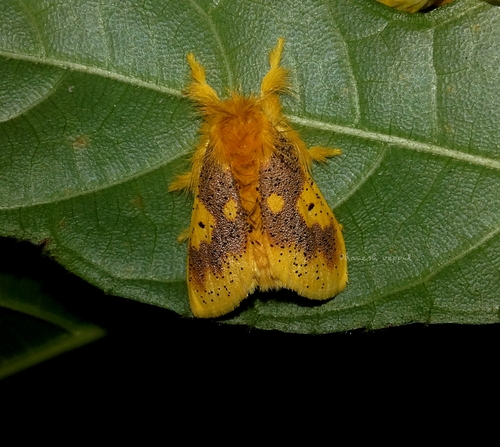
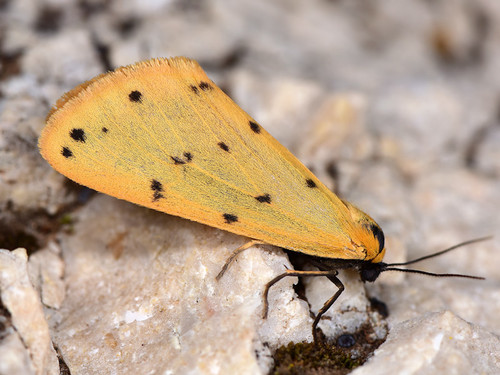
Technical description and variation: The wingspan of Setina irrorella measures 27–33 mm, and forewings are 11–18 mm in length. The species is light yellow overall. Three transverse lines of tiny black dots cross the forewing, while the hindwing usually has only a single dot at its apex. The underside of the forewing is glossy sooty grey, except for a somewhat irregular yellow outer margin. Typical specimens have multiple recorded aberrations. In aberration ab. signata Borkh., the middle rows of spots are united by streaks. Aberration ab. fumosa Sandb. has a distinctly brownish ground colour; it was first described from northern locations, but also occurs in Germany. The species also shows strong geographic variation: The form flavicans Bdv., found in the Mediterranean and Anterior Asia, has brighter, deep yellow wings and a yellow abdomen apex. Form nickerli Rebel is paler yellow, with a slightly dulled forewing except for a clearer yellow inner margin. It occurs in the Alps and Northern Europe, and is often labelled as freyeri in collections. True freyeri Nick., however, is documented by Rebel as a much smaller insect from the highest Alps, in which the dots of the central rows sometimes merge. The black basal forewing spot noted by Rebel is not a key distinguishing feature, and pale yellow colouration occurs in both nickerli and freyeri. Form andereggi H.-Schiff. has dark forewing veins that appear ray-like, and is found in the high Alps and higher North. Form riffelensis Fall. is considerably smaller, with a slightly dulled ground colour and more numerous black vein-streaks; particularly the costa and median veins are strongly sooty black. It occurs in the high Alps, and is especially abundant above Zermatt. Form lata Christ. is larger with broader, paler wings, and has very few markings; the hindwing is often completely unmarked. Its range extends from Russia through North Siberia to Kamtschatka. Form insignata Stgr. is quite similar to lata Christ., but has narrower wings, very few dots on the forewing, and no markings at all on the hindwing. It occurs in East Siberia.