About Setaria viridis (L.) P.Beauv.
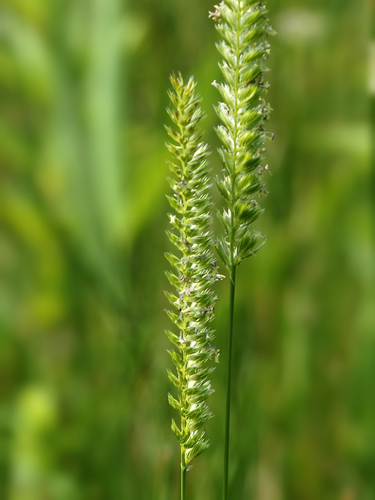
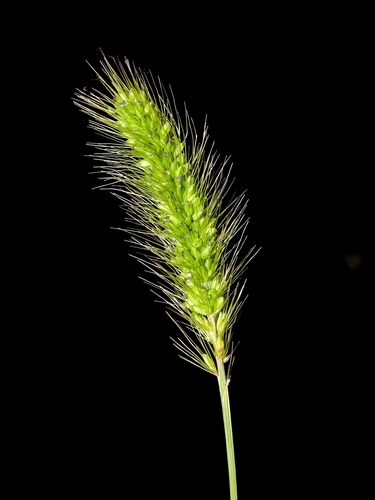
Setaria viridis (L.) P.Beauv. is a grass species with multiple common names: green foxtail, green bristlegrass, and wild foxtail millet. Some sources classify it as a subspecies of Setaria italica. It is native to Eurasia, and has been introduced to most continents. It is closely related to Setaria faberi, a noxious weed. This hardy grass grows in many types of urban, cultivated, and disturbed habitats, including vacant lots, sidewalks, railroads, lawns, and field margins. It is the wild ancestor of the cultivated crop foxtail millet. This is an annual grass with decumbent or erect stems that can grow up to one meter long, and sometimes reach two meters or more in length. Its leaf blades are up to 40 centimeters long and 2.5 centimeters wide, and are glabrous. The inflorescence is a dense, compact, spikelike panicle up to 20 centimeters long, that grows erect or only nods at the tip. Its spikelets measure 1.8 to 2.2 millimeters long. Each spikelet is subtended by up to three stiff bristles. Its fertile lemmas have a fine cross-wrinkled texture. Setaria viridis is often confused with S. faberi, also called Chinese or Giant Foxtail, which has sparse soft hairs on its leaves and a fully nodding inflorescence. It is closely related to S. italica, Foxtail Millet, which has larger spikelets around 3 millimeters long, and typically has smooth, shiny upper lemmas. Foxtail millet was being cultivated in China by 2700 BC, and was cultivated in Europe during the Stone Age. Setaria viridis has been proposed as a model organism for the study of C4 photosynthesis and related bioenergy grasses. It has a short 6 to 8 week life cycle, is genetically transformable, and its genome is currently being sequenced. Multiple research groups are actively developing genetic resources for this species. A method to break the prolonged seed dormancy of this species has been discovered recently. All of these traits contribute to the potential for S. viridis to become a favored monocot genetic model system.