About Setaria palmifolia (J.Koenig) Stapf
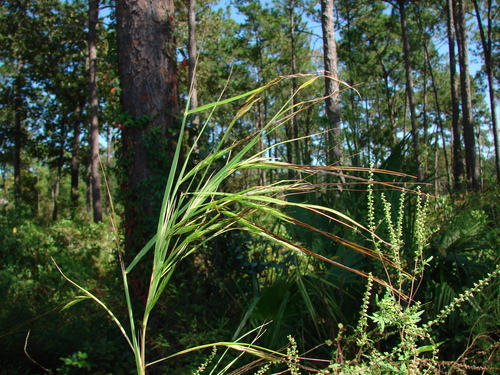
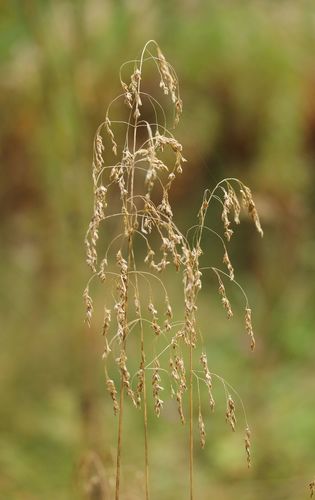
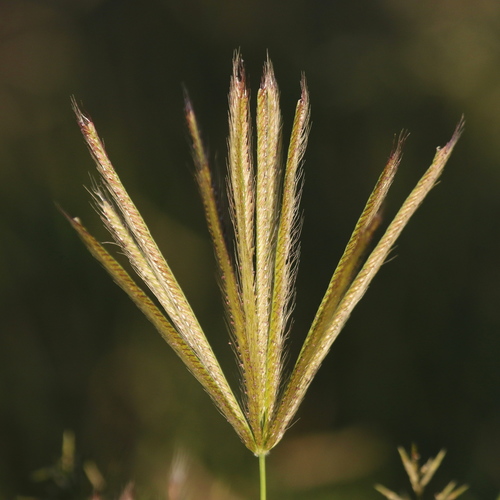
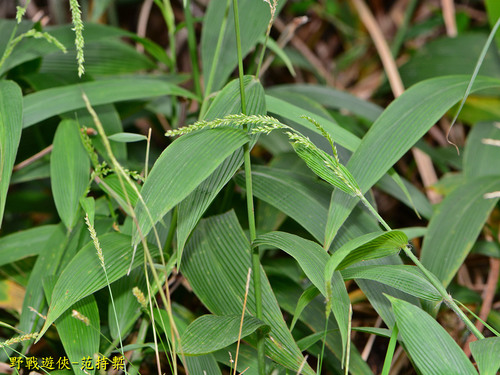
Setaria palmifolia (J.Koenig) Stapf is a perennial grass that grows from a knotty rhizome. Its stems reach 2 to 3 metres (6½ to 10 ft) in length, and can grow up to 1 centimetre thick. Leaf sheaths range from sparsely hairy to fully covered in hairs. Leaf blades are linear, oval, or lance-shaped, growing up to 60 to 80 cm (24 to 31 in) long and 7 to 8 cm wide. The blades have a pleated texture, and are either hairless or carry some rough hairs. The inflorescence is a loose, open, spreading panicle that can reach 80 cm long. Each spikelet is a few millimetres long, and is often accompanied by a bristle up to 1.5 cm long.
This species is native to temperate and tropical Asia. It has been introduced to many other regions, where it is often classified as invasive. It is present as an introduced species in Australia, New Zealand, many Pacific Islands, and the Americas. It was often introduced to new areas as an ornamental plant, and is now widespread across Pacific Islands. It has established as an invasive species on Lord Howe Island, Norfolk Island, Rapa Nui, Fiji, the Solomon Islands, Samoa, and Hawaii, as well as in New Zealand and Queensland, Australia.
This is a robust grass that spreads via rhizomes and seed banks, forming dense single-species (monotypic) stands. As a tall plant with broad leaves, it shades out and outcompetes native vegetation. In Hawaii, feral pigs facilitate its spread by uprooting surrounding plants while feeding on its thick stems; the species is also spread by seed-eating birds. This grass acts as a host for the fungi Cercospora setariae and Phacellium paspali.
It is cultivated as an ornamental plant valued for its palm-like pleated leaves. Some cultivars produce striped leaves, while the cultivar 'Rubra' has purple leaf midribs. In Papua New Guinea, it is grown as a vegetable crop, where it is called highland pitpit. Its stems are eaten after cooking, and its grain can be consumed as a rice substitute.