About Sesbania tomentosa Hook. & Arn.
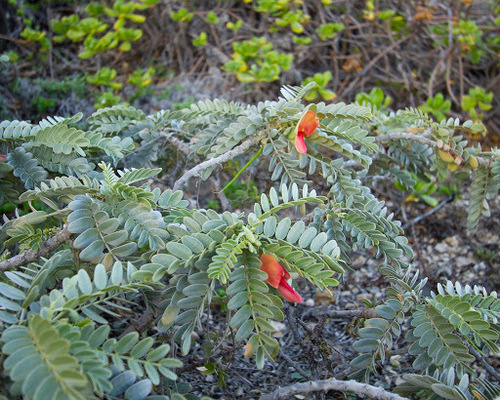
Sesbania tomentosa Hook. & Arn., commonly called Oahu riverhemp or ʻōhai, is an endangered plant species in the pea family Fabaceae. It is endemic to the main Hawaiian Islands, as well as Nīhoa and Necker Island. This species grows in low shrublands, and rarely in dry forests, at elevations ranging from sea level to 760 meters (2,500 feet). Native plant species that grow alongside it include ʻakiʻaki (Sporobolus virginicus), ʻilima (Sida fallax), naupaka kahakai (Scaevola taccada), and pili (Heteropogon contortus). Off-road vehicles, wildfires, grazing, and competition from non-native alien species have destroyed much of this species' habitat on the main Hawaiian Islands. However, it remains quite common on Nīhoa and Necker Island. At least 2,000 individual specimens grow on Nīhoa, while far fewer grow on Necker. ʻŌhai is highly polymorphic, showing wide variation in flower and plant color and shape. Plants growing on Nīhoa produce reddish-orange flowers and relatively hairless young leaflets. Plants from Necker have salmon to orange flowers, and very hairy leaflets. A tree-forming growth form of ʻōhai occurs on Molokaʻi. At Ka Lae, the southernmost tip of the island of Hawaiʻi, ʻōhai grows as a prostrate shrub with semi-glaucous hairless leaves.