About Sesbania punicea (Cav.) Benth.
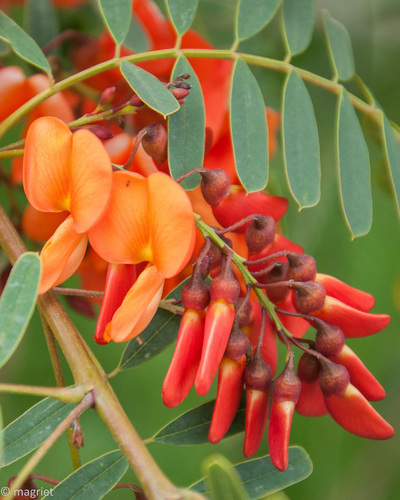
Sesbania punicea (Cav.) Benth. is a shrub with morphological traits including alternate, deciduous compound leaves, which carry 5 to 20 pairs of elliptical leaflets per stalk. Leaf margins are usually entire, with little to no serration, and each oblong leaflet ends in a pointed tip. Stipules on the leaves are typically inconspicuous. Flowers and fruits droop at the tips of stalks. The shrub has relatively thin branches that are green when young, and darken to red-brown as they mature. Its bark ranges from gray-brown to red-brown, with visible horizontal lenticels. This species is native to Brazil, Argentina, Paraguay, and Uruguay. It has spread to other regions of South America, many coastal areas of the southern United States, and parts of Africa. Due to its high water requirement, it is most often found on marshy shorelines, where it forms dense thickets and thrives in disturbed areas. Its flowering period runs from late spring through autumn: in the United States, it blooms between June and September, while in South Africa it blooms between November and January. When carpellous structures dry out, seeds fall close to the base of the parent plant. Seed coats are impermeable to water, a trait caused by callose, that allows seeds to be dispersed by water, which is why the species is often found near rivers and streams. It is also commonly found near roadsides, likely because seeds were transported with construction soil. The species is shade-tolerant. Seedlings can produce flowers and seeds as early as three months after growth, though flowering most typically occurs when the plant is two years old. It can survive light frost, but cannot tolerate prolonged frosty conditions. Sesbania punicea contains toxic saponin glycosides that are dangerous to native birds and mammals. If humans ingest the plant or its seeds, they can become severely ill, experiencing symptoms including vomiting, diarrhea, respiratory failure, and death.