About Serruria fasciflora Knight
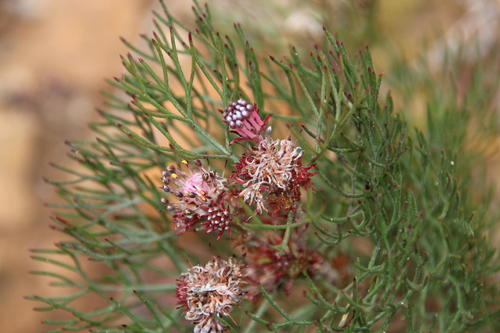
Serruria fasciflora is a much branched, sprawling to upright perennial shrublet, growing 40 cm to 1 m (1⅓–3⅓ ft) high and about ½ m (1⅔ ft) wide. Its stems are purplish, covered in felty or powdery hairs that are lost as the plant matures. It produces green, sparsely hairy leaves that measure 3–7 cm (1.2–2.8 in) long and 2½–3½ cm (1.0–1.4 in) wide, and are twice finely divided in their upper half to two thirds. The farthest leaf segments are up to about 2 cm (¾ in) long, awl-shaped to nearly thread-shaped, and end in a very sharp tip. This species produces a broad corymb of 10 to 15 flat-topped flower heads, carried on a short hairy stalk enclosed by leaves. Stalks for individual flower heads are 0.65–1.9 cm (¼–¾ in) long, slender, and densely covered in soft hair, with a single awl-shaped, softly hairy bract about 4 mm (0.16 in) long just below each head. Each flower head is around 8 mm (⅓ in) across, holds 5 to 7 silvery pink, sweetly scented flowers, and is subtended by a lance-shaped floral bract. The felty bract that subtends each individual flower is roughly oval, with a thickened, hairless glandular tip when mature, and is about 3 mm (0.12 in) long. The 4-merous flowers are slightly curved before opening. The perianth-tube, the lower part that remains merged when the flower opens, is covered in long soft hairs and about 1½ mm (0.06 in) long. The middle part, or claws, consists of four segments each about ½ cm (0.2 in) long, linear to thread-shaped, with short densely matted woolly hairs pressed to their surface. The upper part, or limbs, which enclose the pollen presenter in the bud, are 1½ mm (0.06 in) long, elliptic with an almost sharp tip, and covered in densely matted woolly hairs. The four anthers are each attached almost directly to the limbs and measure about 1.4 mm (0.055 in) long. A 5–7 mm (0.20–0.28 in) long style emerges from the center of each flower, topped by a slightly sharp, almost hoof-shaped stigma that is ¾ mm (0.03 in) long. The ovary is covered in fine, soft, short hairs. The inverted egg-shaped fruit is about 4 mm (0.16 in) long and has short felty hairs on its upper half. Serruria fasciflora is widespread across flats and mountainous areas, ranging from the West Coast as far north as Hopefield, south to the Cape Peninsula, and east to the Outeniqua Mountains. On the Cape Peninsula, it is common on the lower slopes and sands of Muizenberg. It grows in an extremely variable range of habitats, occurring between sea level and 600 m (2000 ft) elevation. It can tolerate windy, hot, dry summers and cool wet winters, but cannot survive frosts. This species is specifically adapted for pollination by flies, attracted by its very sweet scent. Commonly called the common pin spiderhead, it survives regular fynbos wildfires via its seeds. Fruits fall to the ground around two months after flowering. The fruits have a fleshy covering called an elaiosome that secretes a pheromone to attract ants. Native ants collect the fruits and carry them to their underground nests. The elaiosomes are eaten at the nest, and the seeds remain underground until they germinate when conditions are favourable.