About Serratula tinctoria L.
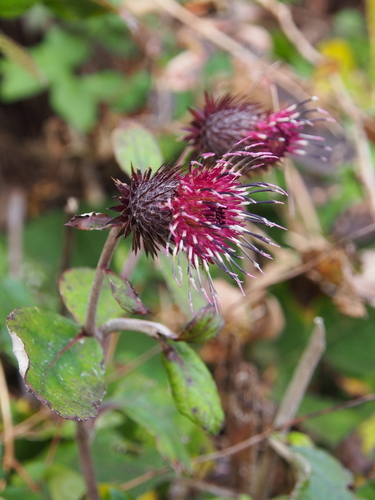
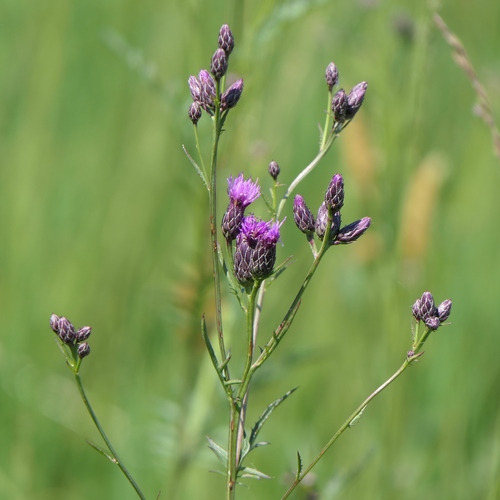
Saw-wort (Serratula tinctoria L.) is a spineless, hairless perennial herb with wiry, branched, erect, grooved stems. It usually grows to 20–80 cm tall. Its long, hairless leaves are 12–20 cm in length, with finely bristle-toothed edges. Leaves are arranged alternately along the stem, and vary in shape and size, ranging from undivided and lanceolate to deeply pinnatifid with narrow lobes. Only the lower leaves are stalked. The stalked, thistle-like flowerheads are 1.5–2 cm long, and arranged in loose leafy inflorescences. The 5-lobed florets are reddish purple, and the involucre is narrow oblong. The purplish bracts are oval and pointed, not spiny, and appressed to the stem. The achenes have a simple feathery yellowish pappus. S. tinctoria grows across various soil types overlying a range of rock types, but is almost always restricted to semi-natural vegetation in habitats with low soil fertility and low levels of disturbance. It typically favours moist soils with full sun to partial shade, growing in grasslands, mires, open woodland, scrub, and the ecotones between these habitats. The species is widespread across much of England and Wales, but very rare in Scotland. It was first recorded in Ireland at New Ross, County Wexford in 1925, and has not been seen there since 1952. Across Europe, its range extends north to southern Sweden and Norway, but it is absent from most of the Boreal Zone, including northern Poland, Russia, Fennoscandia, and the Baltic States, as well as from the lowland Mediterranean. S. tinctoria has declined in Britain since at least the 19th century, primarily due to a combination of drainage, ploughing, agricultural improvement, and lack of management via cutting and grazing in grasslands. It is an introduced plant in a small area of the north-eastern United States. The leaves of Serratula tinctoria produce a yellow dye. As a herbal preparation, the plant was historically believed to help repair ruptures and heal wounds.