About Serpophaga subcristata (Vieillot, 1817)
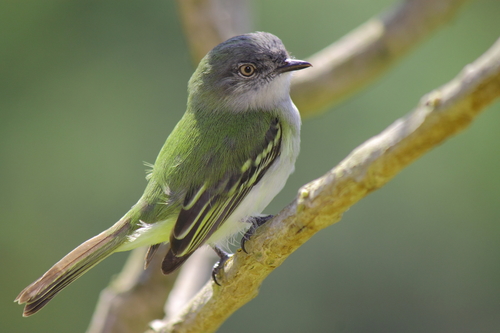
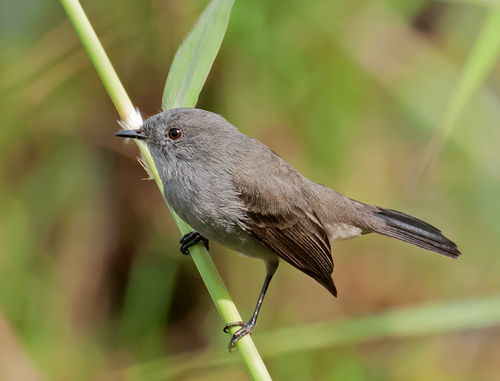
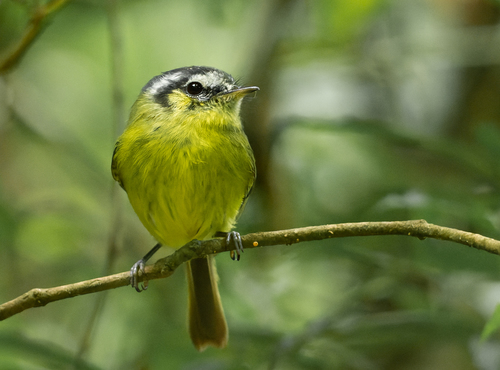
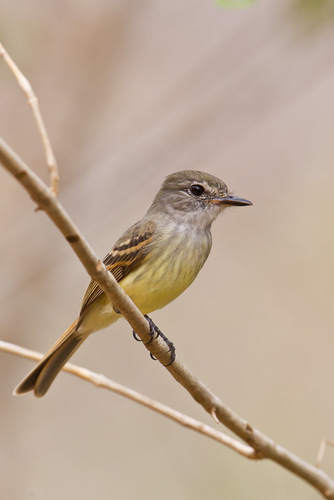
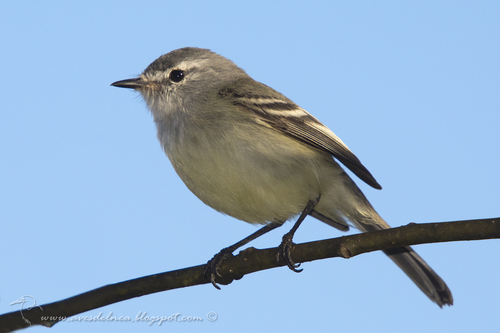
The white-crested tyrannulet, scientifically named Serpophaga subcristata (Vieillot, 1817), measures 11 cm (4.3 in) long and weighs 6 to 8.6 g (0.21 to 0.30 oz). Both sexes of this species share identical plumage. Adults of the nominate subspecies have a gray crown and nape, with white feathers along the center of the crown that are usually hidden but sometimes raised to form a crest. They have a thin white supercilium, a partial white eye-ring, and a dusky line running through the eye, set against an otherwise grayish white face. Their upperparts are grayish olive. Their wings range from dusky to blackish, with pale buffy edges on most flight feathers and two whitish to pale buffy wing bars. Their tail is dusky, with whitish edges on the outermost feathers. Their chin and throat are white, their breast is gray, and their belly is pale yellow. Juveniles have buff wing bars and little to no white on the crown. Subspecies S. s. straminea is very similar to the nominate subspecies, but has a brighter yellow belly. Subspecies S. s. munda is larger than the nominate; it has gray upperparts with a faint olive tinge, white wing bars, and a white belly that sometimes has a faint creamy yellow tinge. Both sexes of all subspecies have a dark brown iris, a black bill, and gray legs and feet. The nominate subspecies of white-crested tyrannulet is distributed from Bolivia's La Paz Department east to southern Mato Grosso in Brazil, and south through Paraguay to northeastern Chubut Province in Argentina. Subspecies S. s. straminea is found in Uruguay and eastern Brazil. Subspecies S. s. munda occurs from western Bolivia and Argentina west of the range of S. s. straminea, and migrates east to north-central Bolivia, southeastern Brazil, and Uruguay. Year-round, this species lives in a wide variety of landscapes, including tropical forest edges, deciduous woodlands, gallery forest, thorn forest, moderately dry scrublands, cerrado, plantations, gardens, and agricultural areas. During the non-breeding season, it tends to favor more open landscapes such as scrublands and agricultural areas. Its elevation range reaches from sea level up to 2,800 m (9,200 ft) in Brazil, up to 700 m (2,300 ft) in Argentina, and up to 2,900 m (9,500 ft) in Bolivia.