About Serpophaga cinerea (Tschudi, 1844)
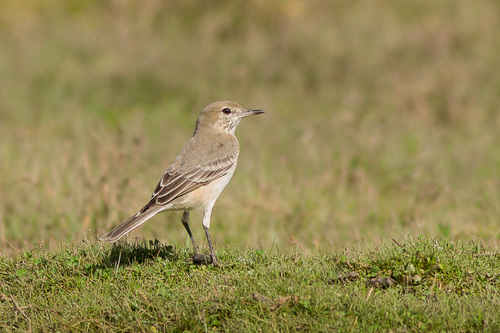
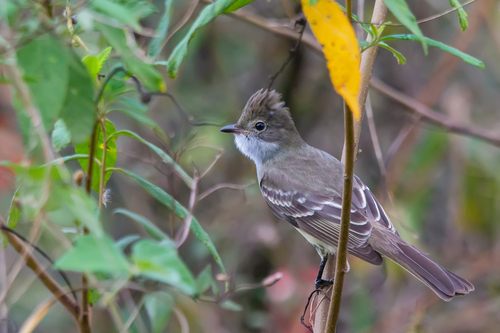
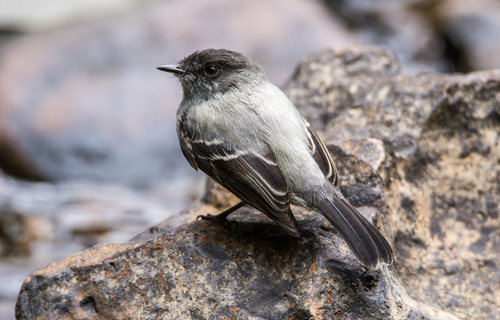
The torrent tyrannulet, Serpophaga cinerea, measures 9.5 to 12 cm (3.7 to 4.7 in) in length, with an average weight of 8.3 g (0.29 oz) across eight measured individuals. Adults of the nominate subspecies have a mostly black head with a partially hidden white patch at the center of the crown. Their back, rump, and uppertail coverts are gray, their wings are mostly black with gray or grayish white edges on the coverts, and their tail is black, sometimes with indistinct grayish white tips on the feathers. Their chin and throat are grayish white, the center of the breast and the belly are white, and the undertail coverts are slightly grayish. Adult females have slightly duller black crowns and napes than males, and may have a smaller white crown patch or no patch at all. Juveniles have a dusky crown mixed with some dull gray, and brownish gray upperparts that are darker on the uppertail coverts. The subspecies S. c. grisea is smaller and paler than the nominate subspecies, and has less white in its crown. Both sexes of both subspecies have a dark brown iris, a black bill, and black legs and feet.
The torrent tyrannulet has a disjunct distribution across two subspecies. The more northern subspecies S. c. grisea ranges from the Cordillera de Tilarán in southern Alajuela Province, Costa Rica, south to Veraguas Province in western Panama. The nominate subspecies occurs in the Andes of Venezuela's Trujillo, Mérida, and Táchira states; in the Serranía del Perijá along the Colombia-Venezuela border; in the isolated Sierra Nevada de Santa Marta in northern Colombia; along all three chains of the Colombian Andes; and south through central Ecuador and central Peru into western Santa Cruz Department, Bolivia. Isolated populations of the nominate subspecies also live in west-central Peru.
This species is a bird of rocky fast-flowing mountain streams, found primarily in the highlands and less often at lower elevations with slower flowing water. It favors relatively small watercourses in forested terrain, though it also occurs on streams in more open landscapes, and is occasionally found in marshes and flooded forest. Its elevation range varies by region: in Costa Rica it mostly occurs between 500 and 2,200 m (1,600 and 7,200 ft), and occasionally lower on the Caribbean side (there is a nesting record from Costa Rica at about 35 m (115 ft), possibly from birds displaced by hydroelectric work higher up the Sarapiquí River). It occurs between 1,500 and 2,200 m (4,900 and 7,200 ft) in Venezuela, between 500 and 3,200 m (1,600 and 10,500 ft) in Colombia, mostly between 700 and 3,100 m (2,300 and 10,200 ft) in Ecuador, between 800 and 3,100 m (2,600 and 10,200 ft) and locally lower in Peru, and between 400 and 2,500 m (1,300 and 8,200 ft) in Bolivia.