About Serinus canaria (Linnaeus, 1758)
The Atlantic canary (Serinus canaria (Linnaeus, 1758)) measures 10 to 12 cm (3.9 to 4.7 in) in length, with a wingspan of 21 to 23.7 cm (8.3 to 9.3 in) and a weight ranging from 8.4 to 24.3 g (0.30 to 0.86 oz), with an average weight of approximately 15 g (0.53 oz).
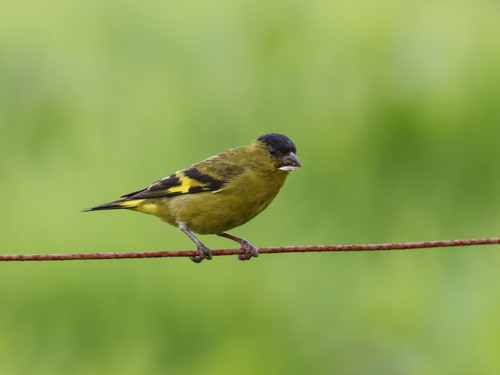
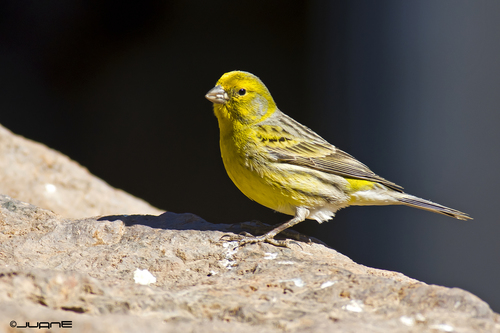
Adult males have a mostly yellow-green head and underparts, with brighter yellow coloring on the forehead, face, and supercilium. Their lower belly and undertail-coverts are whitish, with dark streaks along the sides. The upperparts are grey-green with dark streaks, and the rump is dull yellow. Females are similar in appearance to males but have duller overall coloring, a greyer head and breast, and less yellow on the underparts. Juvenile Atlantic canaries are mostly brown with dark streaks. This species is around 10% larger, longer, and less sharply contrasted in patterning than its close relative the European serin. Its plumage includes more grey and brown tones, and it has relatively shorter wings. The song of the Atlantic canary is a silvery twittering, similar to the songs of the European serin and citril finch.
The Atlantic canary is endemic to the Canary Islands, Azores, and Madeira, part of the Macaronesia region in the eastern Atlantic Ocean. Within the Canary Islands, it is common on Tenerife, La Gomera, La Palma, and El Hierro; it has a more restricted distribution on Gran Canaria, and is rare on Lanzarote and Fuerteventura, where it has only started breeding recently. It is common across Madeira, including Porto Santo and the Desertas Islands, and has been recorded on the Savage Islands. In the Azores, it is common on all of the islands. Total population estimates are 80,000–90,000 breeding pairs in the Canary Islands, 30,000–60,000 pairs in the Azores, and 4,000–5,000 pairs in Madeira.
This species occupies a wide variety of habitats, from pine and laurel forests to sand dunes. It is most abundant in semiopen areas with small trees, such as orchards and copses, and is frequently found in human-made habitats including parks and gardens. Its elevation range extends from sea level up to at least 760 m in Madeira, 1,100 m in the Azores, and above 1,500 m in the Canary Islands. Introduced populations have become established on Midway Atoll in the northwest Hawaiian Islands, where the species was first introduced in 1911. It was also introduced to nearby Kure Atoll, but failed to establish a permanent population there. Birds introduced to Bermuda in 1930 quickly began breeding, but populations began to decline in the 1940s after scale insects destroyed most of the island's Bermuda cedar population; the introduced population was extinct by the 1960s. The species has also been observed in Puerto Rico, where no established population exists, and it is also found on Ascension Island.
The Atlantic canary is a gregarious species that often nests in groups, with each breeding pair defending a small territory. Its nest is cup-shaped, built 1–6 meters above the ground in a tree or bush, most often at a height of 3–4 meters. Nests are well hidden among leaves, usually at the end of a branch or in a tree fork. They are constructed from twigs, grass, moss, and other plant material, and lined with soft materials such as hair and feathers. Egg laying occurs between January and July in the Canary Islands; from March to June, with a peak in April and May, in Madeira; and from March to July, with a peak in May and June, in the Azores. Eggs are pale blue or blue-green, with violet or reddish markings concentrated at the broad end. Clutches contain 3 to 4 eggs, and occasionally 5. Pairs raise 2–3 broods per year. Eggs are incubated for 13–14 days, and nestlings leave the nest 14–21 days after hatching, most often between 15–17 days. Inbreeding depression occurs in Serinus canaria, and is more severe during early development under the stressful conditions caused by hatching asynchrony. Hatching asynchrony creates differences in age and size between hatchlings, so the environment for the first-hatched chick is relatively low-stress, compared to the more stressful environment experienced by the last-hatched chick.